
Truck Lift Capacity Requirements for Your Shop
Truck Lift Capacity Requirements for Your Shop
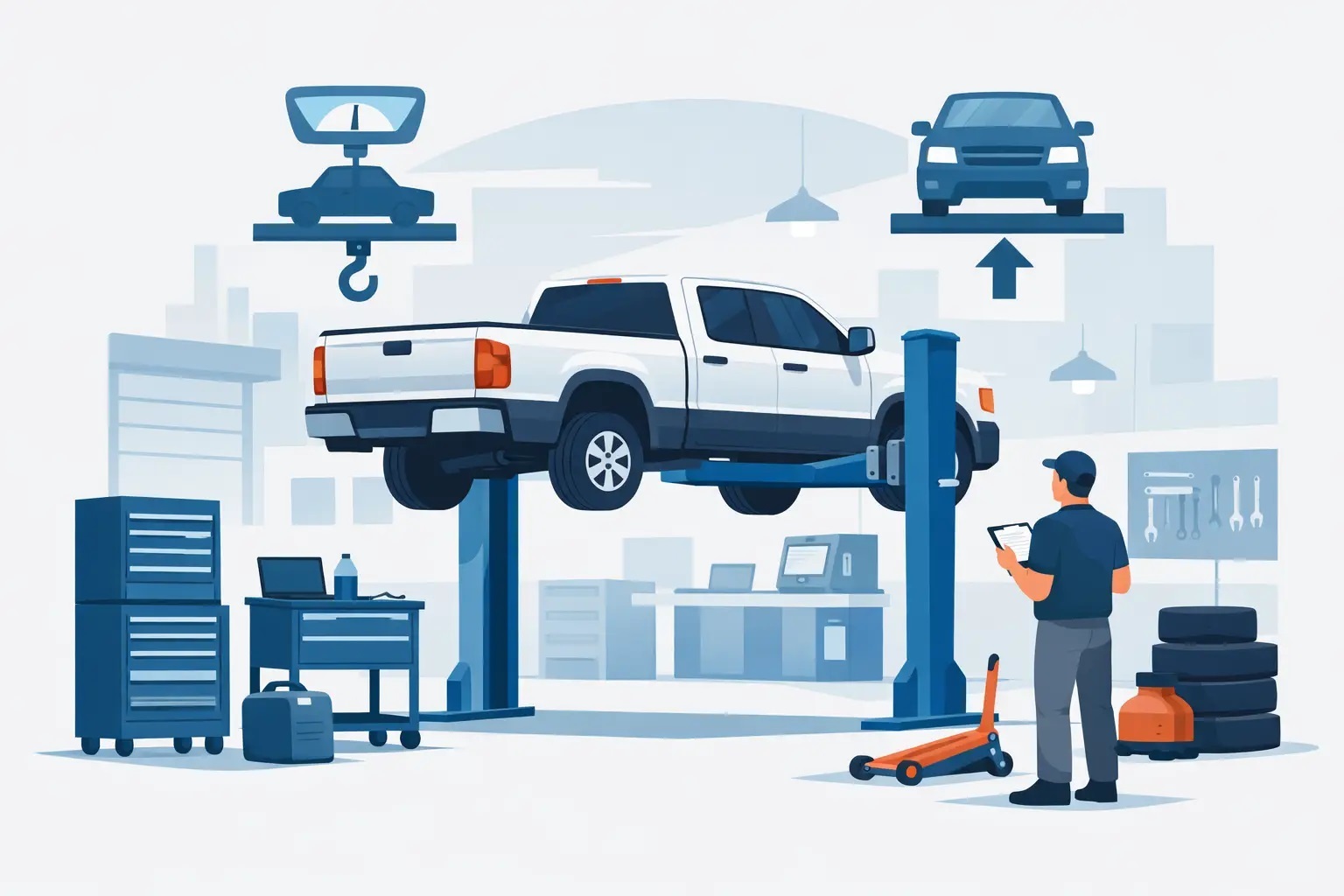
A 10,000-lb lift can be an excellent choice for passenger vehicles and lighter pickups, but it is not automatically the right answer for a shop that regularly sees loaded service bodies, diesel crew cabs, utility trucks, or fleet vans. Truck lift capacity requirements start with the heaviest vehicles you will actually service, then account for how those vehicles are loaded, where their weight sits, and what work needs to happen underneath.
Buying too little lift creates daily limitations and safety concerns. Buying far more capacity than the work requires can add unnecessary cost, take up more bay space, and demand a heavier installation package. The right target is a lift that fits your current workload and gives the shop practical room to grow.
Start With Actual Vehicle Weights
The vehicle's curb weight is only a starting point. A truck that appears to fit within a lift's rated capacity may be significantly heavier once it arrives with tools, fuel, cargo, racks, aftermarket bumpers, plows, service bodies, or upfit equipment. Fleet vehicles are especially easy to underestimate because the chassis rating and the vehicle's in-service weight are not the same thing.
Use the actual gross vehicle weight rating, or GVWR, as a planning reference when the vehicle may be loaded in normal service. Better yet, obtain scaled weights for recurring fleet units. If your operation services an F-250 or Silverado 2500 that is normally empty, a 10,000-lb or 12,000-lb lift may be appropriate depending on the configuration. If that same truck carries a utility body, generator, stocked bins, and a full fuel tank, the answer may change quickly.
Do not select a lift by matching its capacity to the truck's stated weight. Capacity should provide a reasonable operating margin for the vehicles you intend to raise. That margin is not permission to overload a lift. It is a practical allowance for the difference between a brochure specification and the real truck rolling into the bay.
GVWR, Curb Weight, and Lift Rating Are Different Numbers
Curb weight describes the vehicle as equipped by the manufacturer, generally with standard fluids but without passengers or cargo. GVWR is the maximum allowable total vehicle weight established by the manufacturer. A lift's rated capacity is the maximum load the lift is designed to raise under the conditions specified by its manufacturer.
For service planning, GVWR is often more useful than curb weight, but neither number replaces following the lift manufacturer's instructions. A truck must be positioned correctly, supported at approved lift points, and kept within the lift's rated capacity. A 12,000-lb truck lift is not a 14,000-lb lift because the truck has only a few hundred pounds of tools in it.
Match Truck Lift Capacity Requirements to the Work
Capacity is only one part of the buying decision. The lift style determines whether your technicians can lift the vehicle safely and perform the repairs that produce revenue.
Two-post lifts are common in general repair because they provide open wheel access and clear access to brakes, suspension, driveline, and undercar components. For light-duty trucks and SUVs, a 10,000-lb two-post lift is often a productive general-service option. Shops with frequent heavy-duty pickups, commercial vans, and larger fleet units commonly move into 12,000-lb, 15,000-lb, or higher-capacity two-post models.
Four-post lifts are a strong option for alignment work, inspections, storage, and vehicles that are better supported by their tires. They are also useful when long wheelbases or low ground clearance make drive-on loading preferable. Their runway length, width, and wheelbase coverage matter as much as the published capacity.
Scissor lifts can be highly effective for tire, brake, and quick-service work, but they must be selected carefully for truck frame clearance, wheelbase range, and the access required for the job. Heavy-duty mobile column lifts, platform lifts, and multi-post systems serve larger commercial trucks, buses, RVs, and fleet equipment. At those capacities, site engineering and installation planning become central to the purchase.
Consider the Center of Gravity
Truck weight is rarely distributed evenly. Diesel engines, extended cabs, service bodies, toolboxes, liftgates, and loaded cargo areas can shift the center of gravity substantially. This affects arm positioning on a two-post lift and can affect how a vehicle sits on runways or platforms.
A lift may have enough total capacity yet still be a poor match if its arms cannot reach the specified pickup points or if its configuration does not accommodate the truck's weight distribution. Long-arm and asymmetric two-post designs can improve access for many pickups, while symmetric designs may be preferable for certain wider or more evenly balanced vehicles. Review lifting-point coverage, arm reach, pad height, and adapter options before ordering.
Plan for the Longest and Widest Vehicles
A capacity rating tells you how much a lift can raise. It does not tell you whether a crew-cab long-bed pickup, transit van, utility body, or box truck will physically fit.
Check overall vehicle length, wheelbase, track width, tire diameter, and door clearance. On a two-post lift, confirm column spacing and arm reach. On a four-post lift, verify runway length, runway width, and approach ramp clearance. For drive-on equipment, make sure low-slung trucks, specialty vans, and vehicles with extended bumpers can load without interference.
Bay layout also affects the decision. A larger truck lift can require more working area around the vehicle, especially when technicians need room for doors, rolling equipment, tire carts, transmission jacks, or alignment accessories. A crowded bay wastes the productivity gained by a higher-capacity lift.
Concrete, Ceiling Height, and Electrical Requirements
Truck lift capacity requirements do not stop at the lift itself. The building must support the installation. Two-post and heavy-duty lifts have specific concrete thickness, compressive-strength, curing, and anchor requirements. These requirements vary by manufacturer and model, so never assume an existing slab is suitable based solely on its apparent thickness.
Core testing may be necessary in older buildings, locations with unknown slab history, or bays that previously held lighter equipment. Post-tension slabs, cracked concrete, sloped floors, and in-floor heat require additional attention before drilling anchors. If a lift requires a new pad or engineered foundation, address that cost before selecting equipment, not after it arrives.
Ceiling clearance is equally practical. Measure finished floor to the lowest obstruction, including lights, ductwork, sprinklers, doors, and roof trusses. A tall truck on a tall two-post lift may exceed the clear height of the building even when the lift itself fits. Low-ceiling lift configurations can solve some problems, but they may involve trade-offs in lifting height or overhead design.
Confirm electrical requirements as well. Many commercial lifts use 220V single-phase power, while certain heavy-duty applications may require three-phase power. Plan disconnects, wiring runs, air supply if needed, and a qualified installer before delivery day.
Certification and Capacity Labels Matter
For commercial use, evaluate lifts with recognized third-party safety certification, including ALI certification where applicable. Certification is not a substitute for correct installation, inspection, and operator training, but it provides confidence that the equipment has been evaluated against applicable lift safety standards.
Read the data plate and owner's manual for every lift model under consideration. The capacity label, approved lifting points, adapter requirements, maintenance schedule, and operating limitations are part of the equipment specification. Accessories also matter. Truck adapters, frame-contact pads, wheel chocks, rolling jacks, and runway extensions must be rated and used as directed.
A daily visual check should be routine: look for damaged cables, hydraulic leaks, worn lift pads, loose anchors, malfunctioning locks, and unusual operating behavior. Technicians should never improvise with blocks, homemade adapters, or unapproved contact points to make a truck fit a lift.
Choose Capacity for Revenue, Not Just Today’s Parking Lot
A shop that sees mostly half-ton pickups today may still need a 12,000-lb lift if the business plan includes diesel repair, municipal fleets, utility contractors, or commercial van work. Conversely, a small general-repair shop may get better return from multiple properly selected 10,000-lb bays than from one oversized lift that sits idle.
Look at repair orders from the last 6 to 12 months. Identify the heaviest vehicles turned away, the vehicles that tie up a bay because they cannot be lifted efficiently, and the customer segments the shop wants to pursue. Then compare those needs against capacity, lifting height, access, building limitations, and installation cost.
MyToolEquipmentGuy.com has supplied shop equipment since 1984, and the practical buying conversation is usually not just "How much can this lift hold?" It is "What trucks do you need to service profitably, and what does your facility support?" Answer that question with real vehicle data before you buy, and the lift you install will earn its floor space for years.
Recent Posts
-
On-Car Brake Lathe Benefits for Busy Shops
On-Car Brake Lathe Benefits for Busy Shops A customer comes back after a brake job with a pulsing p …9th Sep 2026 -
Automotive Shop Air Compressor Sizing Guide
Automotive Shop Air Compressor Sizing Guide A compressor that looks adequate on a spec sheet can be …9th Sep 2026 -
Buying a Parking Lift for Your Home Garage
Buying a Parking Lift for Your Home Garage A parking lift for home garage use can turn a crowded tw …9th Sep 2026