
On-Car Brake Lathe Benefits for Busy Shops
On-Car Brake Lathe Benefits for Busy Shops
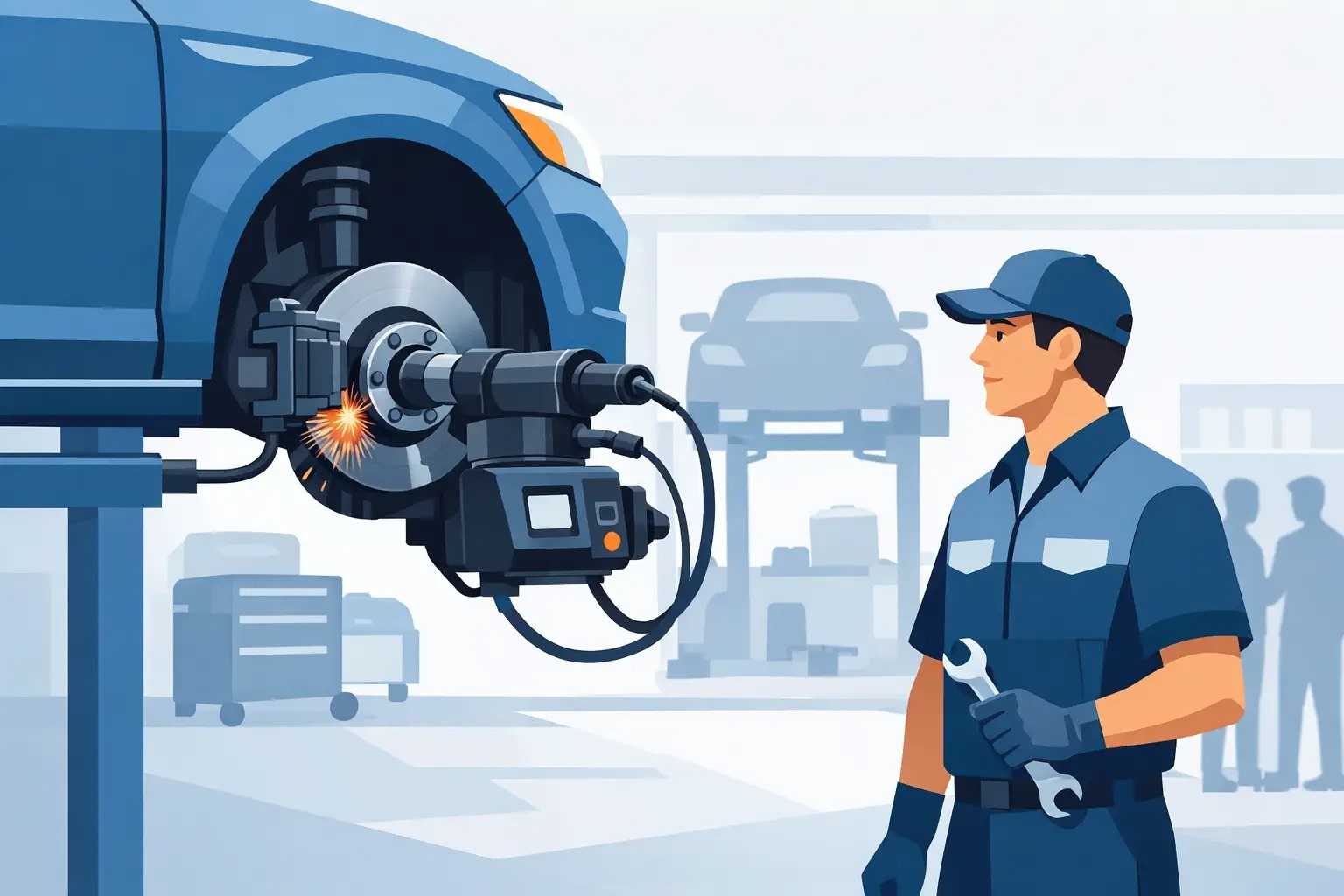
A customer comes back after a brake job with a pulsing pedal, and the technician is left checking every part of the repair again. Often, the pads and rotors were installed correctly. The problem is lateral runout at the hub and rotor assembly. That is where on car brake lathe benefits become very real: the machine cuts the rotor in its installed position, correcting for the runout present on that vehicle rather than machining the rotor on a separate bench.
For independent repair shops, dealerships, tire and brake centers, and fleet operations, an on-car brake lathe can turn a recurring comeback issue into a controlled, repeatable service procedure. It is not the right answer for every brake job, especially when replacement rotors are inexpensive or a rotor is already below specification. But when rotor resurfacing makes technical and financial sense, on-car machining offers advantages that a conventional off-car lathe cannot duplicate.
Why On-Car Brake Lathe Benefits Start at the Hub
A rotor can be machined true on a bench lathe, measured, and installed with care, yet still show excessive lateral runout once it is mounted to the hub. Rust scale, debris, hub face irregularities, wheel bearing play, and stack-up tolerances all affect how the rotor runs on the vehicle.
An off-car lathe corrects the rotor by itself. An on-car brake lathe references the vehicle spindle or hub and cuts both rotor faces while the rotor is mounted in its operating location. Properly set up, it compensates for the combined runout of the hub and rotor assembly. The result is a braking surface that runs true in relation to the vehicle.
This matters because lateral runout can create disc thickness variation over time. As the rotor turns, pad contact varies slightly. Material transfer becomes uneven, and the driver eventually feels pedal pulsation or steering-wheel shake during braking. The complaint may show up well after the original service, which makes it costly for a shop even when the parts supplier covers the rotor.
Pedal Pulsation Is Not Always a “Warped Rotor”
Technicians commonly hear rotors described as warped. In many cases, the condition is better understood as disc thickness variation caused by runout and uneven pad deposits. The distinction matters because it points to the repair process. Replacing rotors without checking the hub surface, lug-nut torque, and runout can leave the same underlying condition in place.
An on-car lathe is not a substitute for inspection. The hub must be clean, bearings and suspension components must be sound, and the rotor must have enough remaining thickness to machine safely. What the machine does provide is a practical way to produce a true friction surface after those checks are completed.
Better Brake Job Consistency and Fewer Comebacks
The primary benefit for a working shop is consistency. A quality on-car lathe gives technicians a process they can follow on vehicles where runout-related brake complaints are common. This is especially useful on late-model vehicles with tighter brake-system tolerances and on fleet vehicles that see frequent stop-and-go operation.
A controlled resurfacing procedure typically includes measuring rotor thickness, checking the minimum machine-to specification, cleaning the hub face, mounting and aligning the lathe, making the finish cut, and applying a non-directional finish when required by the rotor and pad manufacturer. The technician can then document rotor thickness and any runout readings for the repair order.
That discipline does more than improve the immediate repair. It creates a defensible service process. If a customer returns with a concern, the shop has measurements and a record of how the brake work was performed. For fleet managers and dealership fixed operations, that documentation can support quality-control procedures across multiple technicians and bays.
On-Car Brake Lathe Benefits for Rotor Life
Rotor replacement is often the fastest choice, and in some cases it is the only responsible choice. Cracked, deeply corroded, heat-damaged, or undersize rotors should be replaced. Many newer rotors also start with limited excess material, which reduces how often resurfacing is viable.
Still, replacement is not automatically the best value. If a rotor is structurally sound and has enough thickness above its discard specification, machining can preserve a usable component while delivering the surface finish needed for proper pad bedding. That can reduce parts expense for fleet accounts and give independent shops another profitable, legitimate brake-service option.
The key is not to machine simply because a lathe is available. Every rotor must be measured before cutting and checked again afterward. The final thickness must remain above the vehicle manufacturer’s discard specification, with enough margin for expected service wear. A shop that treats resurfacing as a measured repair rather than a default add-on protects both its customer and its reputation.
Shop Throughput Depends on Setup, Not Just Cut Time
On-car lathes are often discussed as a cure for brake-job delays. They can help, but only when the shop plans the workflow. A technician needs access around the vehicle, a stable lift or service bay, correct adapters, clean mounting surfaces, and time to complete the cut without interruption.
For a high-volume brake operation, the lathe’s automatic feed, alignment system, and control layout make a significant difference. Machines designed for fast compensation and consistent finishing can reduce technician adjustment time. Maintenance also matters. Dull cutting bits, damaged adapters, or neglected calibration can erase the accuracy advantage that justified the purchase.
A two-post lift can provide excellent wheel and rotor access for on-car machining, while an alignment lift or drive-on lift may fit a shop’s broader workflow. The right bay layout depends on the vehicles serviced, lift availability, technician traffic, and whether the shop performs general repair, tires, alignments, or fleet maintenance. Equipment purchases should be evaluated as part of the whole brake-service process, not as isolated machines.
Where an On-Car Lathe Makes the Most Sense
An on-car brake lathe generally delivers the strongest return in shops that perform enough brake work to use it consistently and that want more control over pulsation-related comebacks. It is particularly practical for dealerships, fleet shops, municipal maintenance facilities, and independent operations serving a broad range of passenger vehicles and light trucks.
It can also be a strong fit for shops working on vehicles with known runout sensitivity, provided the correct adapters and service information are available. Before buying, consider the vehicle mix. Confirm the machine’s compatibility with the hubs, driveline configurations, and rotor sizes the shop sees most often. A unit that handles common work quickly is usually a better investment than a machine selected only for an occasional edge case.
For shops that mostly install low-cost replacement rotors, the economics may lean toward replacement. The labor rate, local parts pricing, rotor availability, and customer expectations all affect that decision. The best operations offer both options when appropriate and explain the inspection findings clearly.
Buying Factors That Affect Real-World Results
Price matters, but capability and support matter more over the life of the equipment. Look beyond the advertised cutting range and compare the details that affect daily use: motor and drive design, automatic compensation, feed control, included adapters, replacement tooling availability, training requirements, and manufacturer service support.
Also plan for the equipment around the lathe. You need a dependable lift or bay setup, a clean area for tooling, accurate micrometers or digital measuring tools, rotor specifications, and a process for torqueing wheels correctly after reassembly. Improper lug-nut torque can introduce runout after a careful resurfacing job, defeating the purpose of the work.
At MyToolEquipmentGuy.com, brake lathes should be considered alongside the lifts, jacks, tire equipment, diagnostic tools, and shop layout needed to keep brake service moving. A brake lathe is a revenue-producing tool, but it performs best when the surrounding workflow is built to support it.
The practical value of an on-car lathe is simple: it gives a qualified technician a way to machine the rotor where it actually operates. When the rotor is serviceable, the hub is properly prepared, and the final dimensions meet specification, that extra control can mean a smoother brake job and one less customer returning to the service drive.
Recent Posts
-
On-Car Brake Lathe Benefits for Busy Shops
On-Car Brake Lathe Benefits for Busy Shops A customer comes back after a brake job with a pulsing p …9th Sep 2026 -
Automotive Shop Air Compressor Sizing Guide
Automotive Shop Air Compressor Sizing Guide A compressor that looks adequate on a spec sheet can be …9th Sep 2026 -
Buying a Parking Lift for Your Home Garage
Buying a Parking Lift for Your Home Garage A parking lift for home garage use can turn a crowded tw …9th Sep 2026