
Automotive Shop Air Compressor Sizing Guide
Automotive Shop Air Compressor Sizing Guide
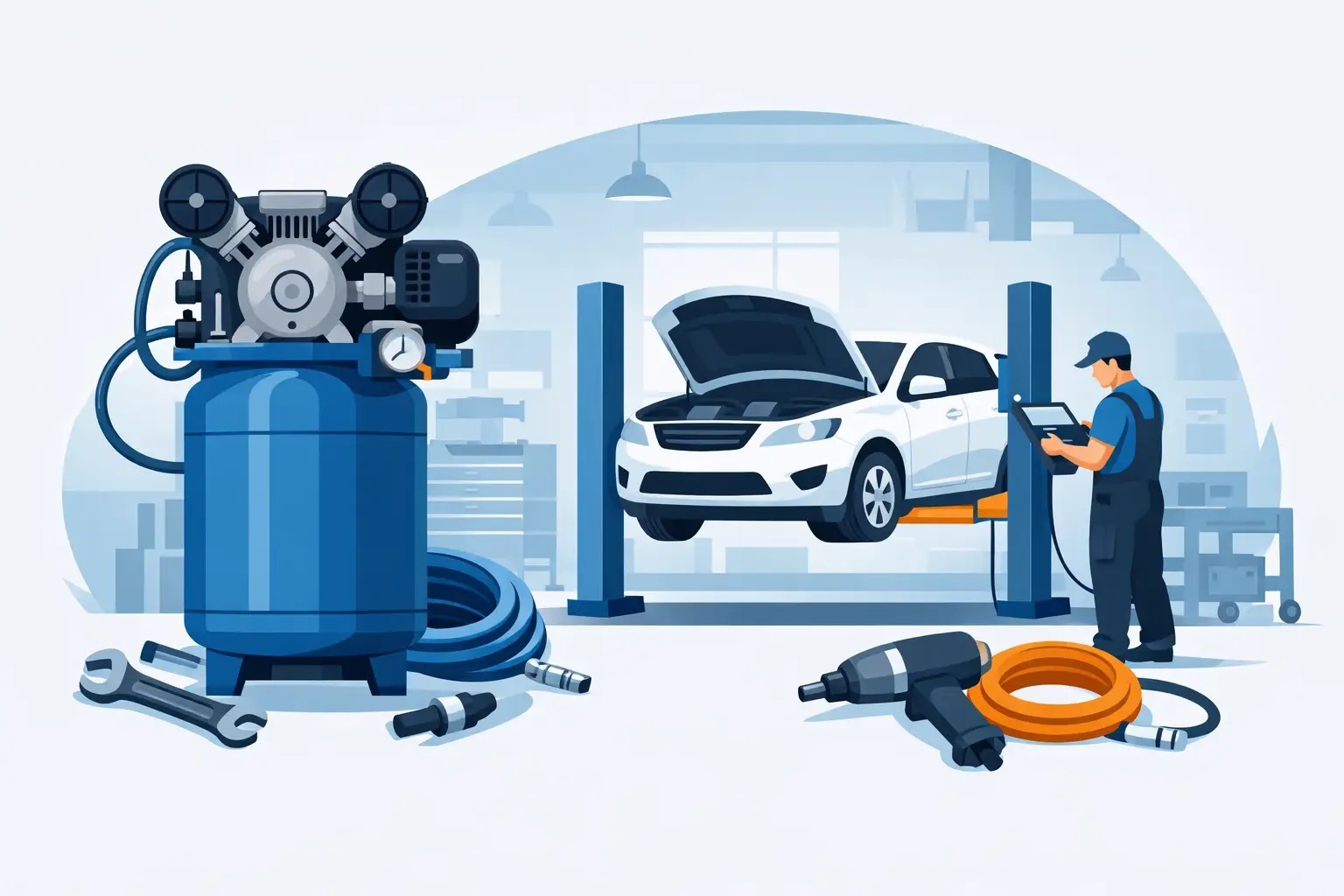
A compressor that looks adequate on a spec sheet can become the slowest piece of equipment in the building. The usual symptoms are familiar: an impact gun loses torque, a tire machine hesitates, water reaches the paint booth, or the compressor runs nearly nonstop. Proper automotive shop air compressor sizing starts with how your technicians actually work, not simply the number of service bays or the largest air tool in the catalog.
For a professional repair facility, compressed air is a utility. It supports revenue-producing work across tires, brakes, body repair, general service, detailing, and paint preparation. Sizing it correctly means balancing required CFM, operating pressure, simultaneous demand, storage, electrical service, air quality, and room to grow.
Start With CFM, Not Tank Gallons
CFM, or cubic feet per minute, is the compressor rating that determines whether it can keep up with air demand. It should be listed as delivered CFM at a stated PSI, commonly 90 PSI or 100 PSI. A large receiver tank can cover short bursts of demand, but it does not create more air. Once the tank pressure drops, the pump must supply the required CFM.
Do not size from a tool's air inlet size or from a compressor's maximum PSI rating. Most automotive air tools need stable pressure in a practical operating range, but their actual air consumption varies widely. A 1/2-inch impact may be used in brief bursts, while a DA sander or die grinder can stay on long enough to expose an undersized system quickly.
Published tool ratings are a starting point, not a final answer. Manufacturers may list average CFM, intermittent-use CFM, or a higher continuous-use requirement. Review the tool manual when available, especially for sanders, grinders, blast cabinets, paint guns, and high-demand tire equipment.
Calculate Real Shop Demand
The right calculation accounts for the tools that can run at the same time. Walk through a normal busy hour, not a quiet afternoon. Consider each bay, tire area, body stall, wash or detail area, and any dedicated equipment connected to shop air.
List every regular air consumer and its stated CFM at the required PSI. Then identify which tools can realistically operate simultaneously. In a four-bay general repair shop, four technicians may all use air, but they are not necessarily holding impact guns wide open at the same instant. In a tire shop, two tire changers, an inflator, bead seating equipment, and air impacts may overlap often enough to justify a larger demand allowance.
For intermittent automotive repair tools, add the CFM of likely simultaneous use and apply a reasonable diversity factor based on your operation. For continuous-load tools, use the full stated requirement. A DA sander, die grinder, abrasive blaster, and many paint-prep operations should be treated much more seriously than a short-burst ratchet or blow gun.
Once you have a realistic operating number, add capacity for pressure loss, hot weather, normal wear, and business growth. A common planning target is a compressor that can deliver roughly 25% to 50% more CFM than calculated normal demand. The exact margin depends on duty cycle and how expensive downtime is in your shop. A facility with one technician can accept a little less reserve than a high-volume dealership lane where air loss stops multiple jobs.
Typical Air Demand by Shop Task
These ranges are useful for early planning, but always verify the specific equipment you intend to install:
- A 1/2-inch impact wrench often uses about 4 to 8 CFM in typical intermittent service.
- Air ratchets and small blow guns commonly fall around 3 to 6 CFM.
- DA sanders and die grinders can require 10 to 20 CFM or more during sustained use.
- Spray guns frequently use about 7 to 15 CFM, depending on the gun, cap, and application.
- Small blast cabinets may require 10 to 20 CFM, while larger blasting systems can exceed that by a wide margin.
- Tire changers and wheel-service accessories vary by design, but should be included when they share the same system.
The critical distinction is duration. Four impacts used briefly do not place the same load on a compressor as one technician sanding a quarter panel for 20 minutes.
Match PSI to the Equipment and the Piping
Most automotive shops distribute air at about 120 to 175 PSI, then regulate it at the point of use. Higher storage and distribution pressure can provide useful reserve, but it does not compensate for inadequate compressor CFM. It can also increase leakage and place added demands on fittings, hoses, regulators, and equipment if the system is not designed for it.
Pressure drop deserves attention before the compressor arrives. Long runs of undersized pipe, restrictive quick couplers, clogged filters, and marginal hose reels can starve tools even when the compressor gauge appears healthy. A technician may see 150 PSI at the compressor and far less at the tool under load.
Plan the air layout as part of the compressor purchase. Use adequately sized main lines, minimize unnecessary restrictions, slope piping toward drain points, and install drops that help keep condensed water out of the air stream. Ring-main piping is often a good choice for larger facilities because air can reach a drop from more than one direction. For a small two-bay shop, a simpler layout can work well if pipe sizing and filtration are not treated as afterthoughts.
Choose the Compressor Type for Duty Cycle
A reciprocating piston compressor is often a practical fit for a smaller repair shop, home garage, or operation with intermittent demand. It can deliver strong value, is familiar to many owners, and can handle normal service-tool use when correctly sized. The trade-off is noise, heat, and lower comfort with long continuous run times compared with a rotary screw system.
Rotary screw compressors are built for sustained shop demand. They are a strong choice for busy multi-bay facilities, tire operations, collision centers, and shops where several technicians use air throughout the day. They generally run quieter and deliver air more consistently during long operating periods, but the upfront investment, electrical requirements, maintenance expectations, and installation planning are greater.
Do not buy a small compressor with the assumption that it will simply run all day. Excessive run time creates heat, accelerates wear, sends more moisture downstream, and leaves no reserve when workload spikes. Review the compressor's rated duty cycle and choose a machine intended for the way your shop earns money.
Tank Size Helps, but It Does Not Fix Undersizing
The receiver tank stores compressed air and reduces rapid cycling. It is valuable when tools create short, high-demand bursts, such as impact use or tire inflation. A larger tank also gives the compressor time to recover between cycles.
Still, tank gallons should follow CFM sizing, not replace it. A 120-gallon tank paired with a low-output compressor may feel acceptable for the first few minutes of a rush, then fall behind. For operations with variable demand, a properly sized air receiver can improve performance and compressor life. For constant-demand sanding, blasting, or production work, delivered CFM remains the limiting factor.
Some shops benefit from a secondary receiver near a high-demand area. This can reduce localized pressure drop, but only when the main compressor and piping can eventually replenish that stored air.
Plan for Clean, Dry Air
Every compressor produces moisture, and automotive work has different air-quality requirements. General service tools need filtration and regular draining to prevent corrosion and contamination. Paint and body work demand much more control. Water, oil carryover, and particulate contamination can ruin finish quality and create costly rework.
A professional system may include an aftercooler, moisture separator, refrigerated dryer, coalescing filter, point-of-use regulators, and dedicated final filtration for paint applications. The exact package depends on compressor type, climate, piping length, and the finish standards your operation must meet.
Keep paint air separate from lubricated tool air whenever possible. Never assume one basic regulator and a disposable filter will protect a spray booth or paint-prep area. If your compressor supplies both service bays and refinishing work, design the filtration stages around the most sensitive use or provide a dedicated clean-air branch.
Check Electrical Service Before You Order
Air compressor horsepower is not the whole story. Confirm voltage, phase, breaker capacity, wire size, disconnect requirements, and whether your building has single-phase or three-phase power. Many larger rotary screw compressors are intended for three-phase power, while smaller shops may be limited to single-phase equipment unless they upgrade the electrical service.
Installation location matters too. Leave service clearance around the unit, provide ventilation, manage heat, and avoid placing a noisy compressor where it disrupts customer areas or technician communication. Compressor rooms need airflow and access for maintenance, not just enough floor space to set the tank.
For a new facility or major expansion, include the compressor, dryer, piping, drains, and electrical work in the same equipment plan as lifts, tire service equipment, and paint systems. Buying these pieces separately without a demand plan is how shops end up replacing a nearly new compressor.
A Practical Sizing Example
Consider a three-bay general repair shop with two technicians using impacts and air ratchets, plus occasional tire service. Their intermittent tool demand may suggest a modest CFM requirement on paper. If the shop also performs brake cleaning, runs a die grinder periodically, and expects a third technician within a year, a compressor sized only for current impact use will be tight from day one.
A better approach is to total likely simultaneous use, treat the grinder as a higher-duration load, then add 25% to 50% reserve. If collision work, regular sanding, blasting, or painting enters the picture, step up to a system designed for continuous demand and include a dryer from the start.
The least expensive compressor is rarely the lowest-cost air system if it limits technician productivity, causes moisture problems, or must be replaced after the shop adds another bay. Size for the work you schedule on your busiest days, leave room for the equipment you plan to add, and make clean, stable air part of the shop build rather than a problem to solve later.
Recent Posts
-
On-Car Brake Lathe Benefits for Busy Shops
On-Car Brake Lathe Benefits for Busy Shops A customer comes back after a brake job with a pulsing p …9th Sep 2026 -
Automotive Shop Air Compressor Sizing Guide
Automotive Shop Air Compressor Sizing Guide A compressor that looks adequate on a spec sheet can be …9th Sep 2026 -
Buying a Parking Lift for Your Home Garage
Buying a Parking Lift for Your Home Garage A parking lift for home garage use can turn a crowded tw …9th Sep 2026