
Top Vehicle Lift Safety Features to Look For
Top Vehicle Lift Safety Features to Look For
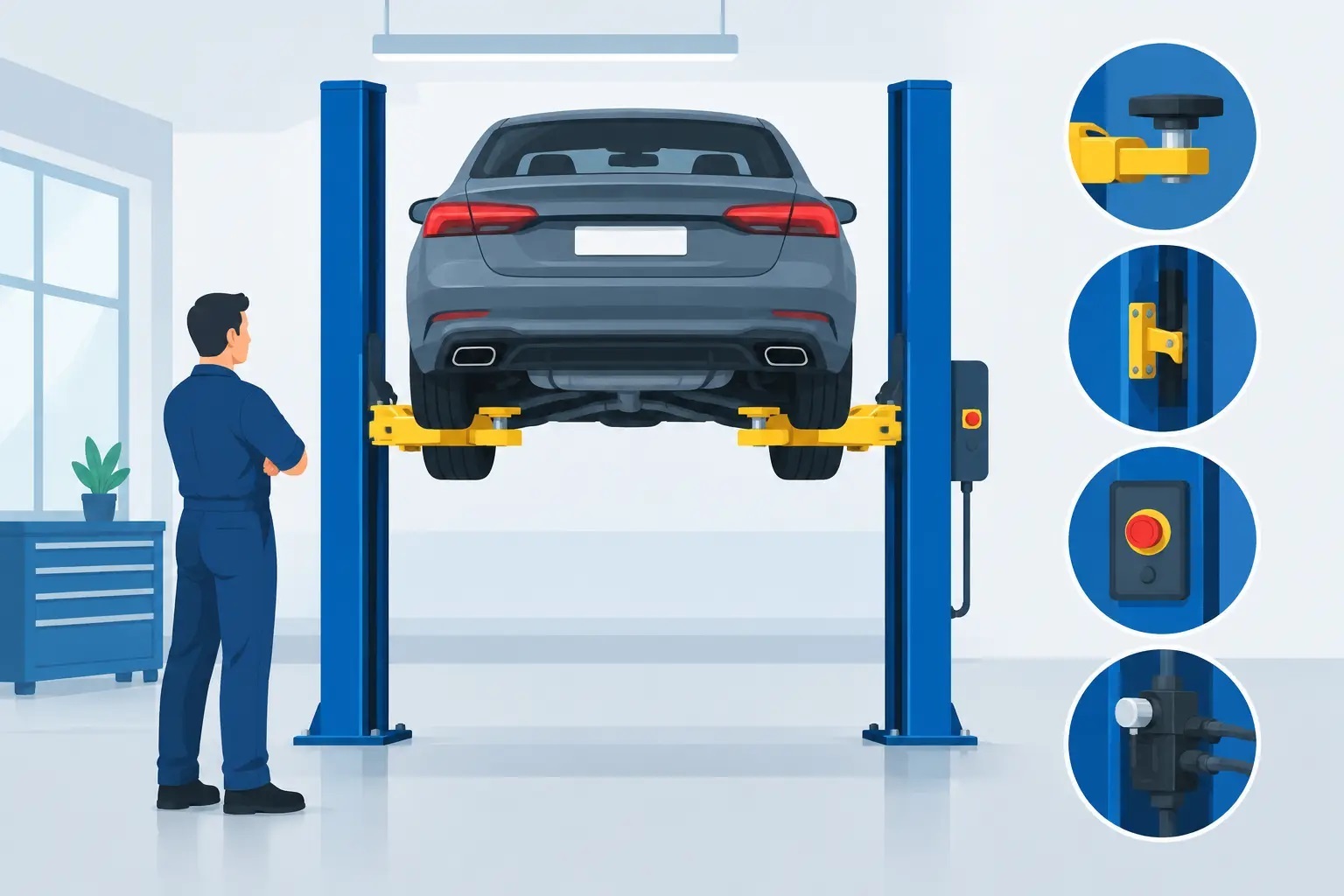
A vehicle lift is only profitable when technicians trust it enough to work under it every day. A few seconds saved on positioning or lifting are not worth a damaged vehicle, an injured employee, or a bay taken out of service for an investigation. The top vehicle lift safety features are not sales-floor extras. They are the mechanical and electrical systems that keep the load supported when operating conditions are less than perfect.
For a professional shop, safety should be evaluated alongside capacity, lifting height, overall width, ceiling clearance, concrete requirements, and service access. For a home garage buyer, the same principles apply, even if the lift sees less daily use. The right feature set depends on whether you are lifting pickups on a two-post, storing collector vehicles on a four-post, servicing tires on a scissor lift, or handling commercial fleet equipment.
Top Vehicle Lift Safety Features That Matter Most
Mechanical safety locks
Every serious vehicle lift needs a positive mechanical means of holding the raised load. On a two-post lift, that generally means ladder-style locks that engage automatically as the carriage rises. On four-post and runway lifts, it usually means mechanical locks that support the runways at set heights. Hydraulic pressure raises the lift, but the locks are what should carry the load while work is being performed.
Look for an automatic lock engagement system and a clearly designed lock release process. The technician should not have to guess whether both sides are seated. A good operating routine is simple: raise the vehicle, lower it slightly until the locks take the load, then verify both sides before anyone goes underneath.
Do not confuse a hydraulic system with a primary holding system. Hoses, fittings, seals, and cylinders require maintenance. Mechanical locks provide a second, independent layer of protection when a hydraulic component fails or pressure drops.
Equalization and synchronization systems
A two-post lift must raise evenly. Depending on the design, that job is handled by equalizer cables, chains, hydraulic circuits, or a combination of components. These systems keep both carriages traveling together so one side does not get ahead of the other and put the vehicle into an unstable position.
Cable equalization is common and dependable when properly inspected and adjusted. Chains can be used in certain designs, while some lifts use more advanced hydraulic synchronization. The best choice depends on the lift configuration, service environment, and manufacturer design. What matters is that the system is accessible for inspection and that the shop follows the adjustment schedule in the lift manual.
On cable-equipped lifts, inspect cables for fraying, corrosion, broken strands, improper tension, and pulley wear. A safety feature only works when it is maintained.
Automatic arm restraints on two-post lifts
On asymmetric and symmetric two-post lifts, arm restraints are among the most important vehicle lift safety features. These mechanisms lock the swing arms into position as the lift rises, preventing an arm from drifting outward under load.
Without effective restraints, a vehicle can become unstable if an arm moves away from the designated lifting point. This risk is especially relevant with unibody vehicles, trucks with uneven weight distribution, and vehicles with limited or unusual lift-point access.
Inspect arm restraint gears, lock teeth, pins, and engagement components for wear. Also check arm pads, adapters, and extension assemblies. A restraint system cannot compensate for arms placed in the wrong location or adapters that do not properly contact the manufacturer-approved lifting points.
Proper lifting adapters and pad retention
Lift pads look simple, but they are the direct connection between the lift and the vehicle. Quality pads should provide stable vehicle contact and stay secured to the lift arm or adapter. Shops working on late-model vehicles, EVs, trucks, and specialty vehicles should have the correct adapter selection available rather than improvising with wood blocks, loose spacers, or damaged pucks.
Truck adapters, frame-engaging pads, low-profile pads, pinch-weld adapters, and EV-specific lifting solutions all have a place depending on the vehicle mix. The trade-off is cost and storage, but the expense is minor compared with a vehicle slipping from an incorrect contact point.
Before lifting, technicians should confirm the vehicle lift points, inspect for corrosion or damage, and make a low-height stability check. Raise the vehicle just high enough for the tires to clear, shake it carefully, and confirm that all pads remain centered before continuing upward.
Hydraulic, cable, and hose failure protection
Hydraulic components deserve close attention because they handle the force required to lift thousands of pounds. Well-designed lifts use properly rated hoses, fittings, cylinders, flow-control components, and routing that limits exposure to abrasion and damage.
Some lift designs include velocity fuses or similar devices that restrict hydraulic flow if a hose fails suddenly. Cable lifts may use slack-cable devices that stop or prevent unsafe movement if a cable loses tension. These protections are valuable, but they do not eliminate the need for daily visual checks.
Watch for hydraulic fluid leaks, damaged hose coverings, cracked fittings, cylinder scoring, unusual noises, and uneven lifting. Take a lift out of service when a safety-related component is damaged. A temporary workaround is not a repair plan.
Controlled lowering and obstruction protection
Lowering is where many avoidable incidents occur. A lift should lower in a controlled manner, with a clear release sequence for its mechanical locks. Operators need an unobstructed view of the area below the vehicle, including tool carts, drain pans, transmission jacks, creepers, and personnel.
Many lifts use audible alarms near the lower portion of travel, toe guards, or pinch-point protection. These features are useful, particularly in busy service bays, but they work best with disciplined communication. Nobody should lower a vehicle until the work area is clear and everyone knows the lift is coming down.
Scissor lifts require special attention around moving structure and pinch points. Four-post lifts require care around runway edges, rolling jacks, and approach ramps. Each lift style has different exposure points, which is why operator training must match the equipment in the bay.
Runway stops, wheel chocks, and approach protection
Four-post lifts, parking lifts, and alignment racks secure vehicles differently than two-post lifts. Their main safety systems include wheel stops, front tire stops, chocks, runways with adequate traction, and ramps designed for the intended vehicle weight and clearance.
The vehicle must be driven onto the runways straight and positioned correctly before lifting. Long-wheelbase trucks, low-clearance cars, and vehicles with wide tires may require specific runway widths, extensions, or ramp options. Never assume a lift that has the capacity for a vehicle also has the correct physical fit.
For alignment lifts, verify that turn plates, slip plates, and wheel stops are installed and functioning as intended. These accessories affect both the quality of alignment work and vehicle retention on the rack.
Certification Is a Buying Factor, Not a Shortcut
For commercial applications, look closely at certification and listing information. ALI-certified lifts have been independently evaluated to applicable safety requirements through an accredited testing process. That can be a major purchase-confidence factor for shop owners, insurers, and facility managers.
Certification does not make an undersized lift safe, and it does not replace correct installation. A 10,000-pound lift should not be selected simply because a truck's published curb weight appears below that number. Add accessories, cargo, uneven front-to-rear distribution, and the type of work being performed. For fleet and truck service, capacity margins become even more significant.
The same applies to accessories. Use arms, adapters, rolling jacks, bridge jacks, and other equipment approved for the specific lift model and rated for the intended load.
Installation Safety Starts Below the Baseplates
The strongest lock system in the world cannot compensate for an inadequate concrete slab or poor anchoring. Before ordering a lift, confirm the manufacturer's requirements for slab thickness, concrete strength, curing time, levelness, anchor specifications, and overhead clearance. Conditions vary by lift model, capacity, and site.
Two-post lifts are especially dependent on proper foundation conditions because the posts transfer substantial forces into the slab. Four-post lifts may be more forgiving in some situations, but they still need a sound, level installation surface. Heavy-duty truck lifts, in-ground systems, and large alignment racks can require more extensive site planning.
Professional installation is often the practical choice for commercial buyers, particularly where electrical work, air lines, anchoring, or building constraints are involved. After installation, establish a documented inspection routine. Daily operator checks, periodic maintenance, and annual professional inspections help catch wear before it becomes a failure.
Buy the Lift That Matches the Work
The safest lift is one that fits the vehicles, the building, and the repair process. A compact low-ceiling two-post lift may be right for a general repair bay but not for a lifted fleet truck. A four-post lift may be ideal for storage and undercar access but less efficient for wheel service without the right jack equipment. A full-rise scissor lift can save space, yet it demands careful attention to vehicle contact points and side access.
MyToolEquipmentGuy.com has been serving the industry since 1984, and the practical lesson remains the same: start with the vehicle mix and the site, then compare lift capacity, configuration, certifications, and safety systems. A properly selected, correctly installed lift gives technicians something better than convenience - confidence every time the controls go up.
Recent Posts
-
Top Vehicle Lift Safety Features to Look For
Top Vehicle Lift Safety Features to Look For A vehicle lift is only profitable when technicians tru …9th Nov 2026 -
Nussbaum Sprinter 7: Fit, Installation, and Use
Nussbaum Sprinter 7: Fit, Installation, and Use The Nussbaum Sprinter 7 is built for a shop that ne …4th Nov 2026 -
Frame Rack or Frame Straightener: Which Fits?
Frame Rack or Frame Straightener: Which Fits? A Frame Rack or Frame Straightener is not a small pu …30th Oct 2026