
How Much Two Post Lift Capacity Do You Need?
How Much Two Post Lift Capacity Do You Need?
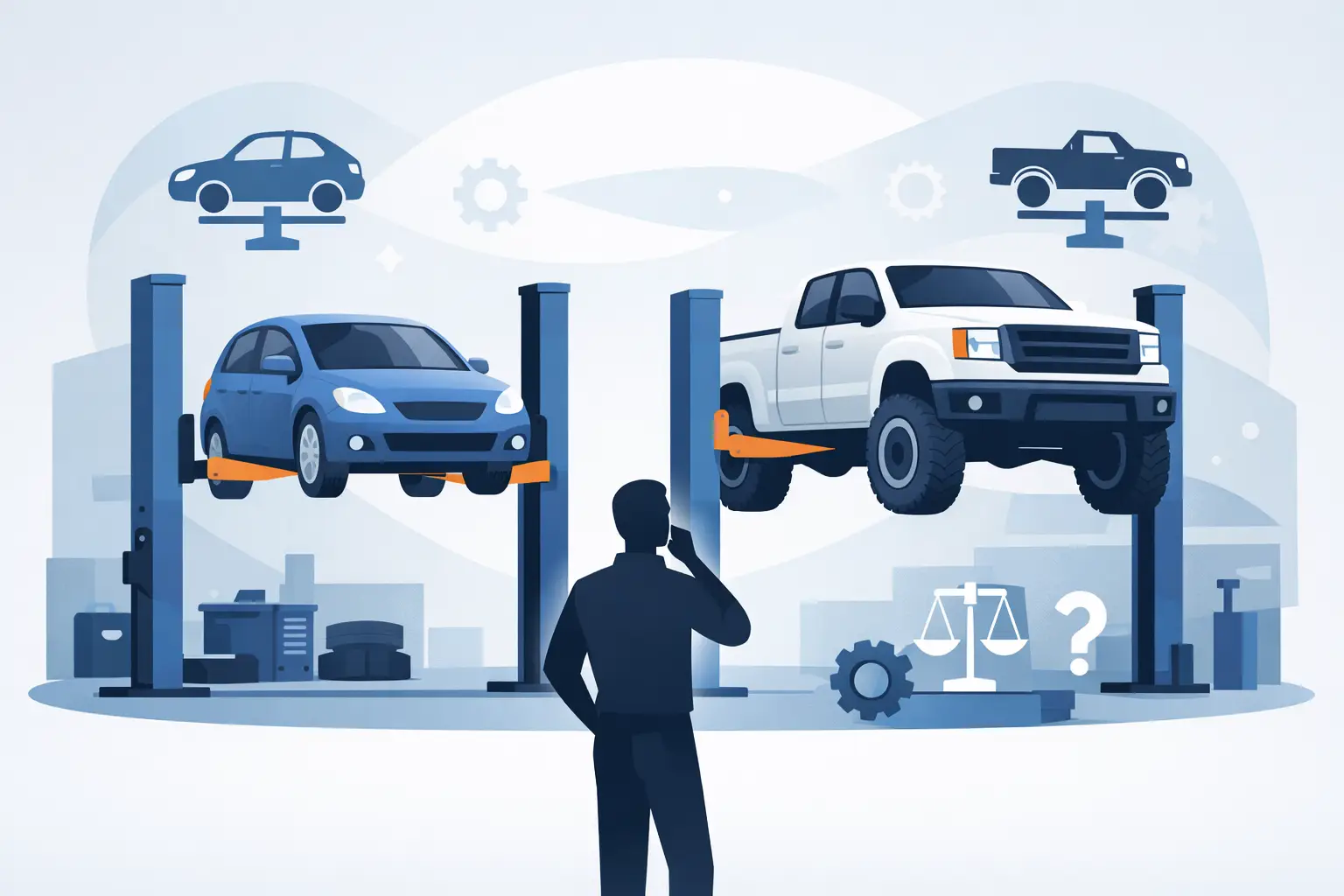
A lift that is technically strong enough can still be the wrong lift for the work you plan to sell. Two post lift capacity affects which vehicles you can safely service, how often you turn away profitable jobs, what installation requirements your building must meet, and how much room you have to grow.
For many general repair shops, a 9,000- or 10,000-pound two-post lift is the everyday sweet spot. That does not mean it is automatically right for every bay. A shop servicing half-ton pickups, cargo vans, EVs, work trucks, or heavily equipped SUVs may need 12,000 pounds or more from day one. The right rating starts with the vehicles you actually see - and the ones you want to see next year.
What Two Post Lift Capacity Really Means
A two-post lift's rated capacity is the maximum total vehicle weight the lift is designed to raise when the vehicle is positioned correctly, the lifting arms are properly engaged, and the installation meets the manufacturer's requirements. It is not a reason to treat the rating as a target weight for every job.
The capacity is shared across the lifting system. Vehicle balance, arm placement, center of gravity, adapter height, and the condition of the vehicle all matter. A 10,000-pound lift is not simply a 7,000-pound lift with extra margin. It usually brings heavier columns, larger carriages, stronger arms, different anchor requirements, and often a wider stance or taller overall design.
That distinction matters with modern vehicles. Battery-electric vehicles can carry substantial weight low in the chassis, while trucks may have long wheelbases, diesel engines, service bodies, toolboxes, or aftermarket bumpers that change their balance. The vehicle's curb weight is only a starting point. Look at its gross vehicle weight rating, common upfits, and the equipment that routinely remains in the vehicle during service.
Common Two-Post Capacity Ranges
7,000 to 8,000 pounds: light-duty service
A lower-capacity two-post lift can work well in a home garage or a light-duty service operation focused on passenger cars, compact crossovers, and smaller SUVs. It can be a cost-conscious choice when vehicle mix is tightly controlled.
The trade-off is clear: capacity can become a limitation quickly. A late-model full-size pickup, larger electric SUV, or commercial van may be outside the lift's rating or close enough to it that the bay is not a practical option. For a commercial shop, saving on initial equipment cost can cost more in lost flexibility over time.
9,000 to 10,000 pounds: the general repair standard
For independent repair shops, tire shops, and dealership quick-service areas, 9,000- and 10,000-pound lifts are common for good reason. They handle a wide share of cars, SUVs, crossovers, and many light trucks while keeping bay requirements and purchase cost within reach.
A 10,000-pound model is often the better long-term value when choosing between nearby ratings. It provides additional working margin for heavier vehicle trims and gives the shop more confidence when a full-size pickup pulls in. Still, capacity alone does not confirm fit. Check the arm reach, minimum arm length, maximum wheelbase coverage, and drive-through width before selecting a model.
12,000 pounds and above: truck, fleet, and heavier vehicle work
A 12,000-pound two-post lift is a stronger choice for facilities that regularly service full-size pickups, diesel trucks, commercial vans, fleet vehicles, and heavier SUVs. Models in this class may offer larger arm assemblies and broader coverage for longer vehicles, but dimensions vary by manufacturer and model.
Above 12,000 pounds, two-post lifts can be highly productive for the right operation. However, building requirements become more consequential. Ceiling height, concrete slab thickness, concrete strength, bay width, electrical service, and delivery access all deserve review before ordering. In some cases, a heavy-duty four-post lift, drive-on runway lift, or another specialty configuration may better suit the vehicle type and work performed.
Size for Your Heaviest Routine Vehicle, Not Your Average Car
The average vehicle in your shop can point you in the wrong direction. A facility may service mostly sedans and crossovers but still rely on pickup, van, or fleet work for its highest-value repairs. If the heaviest routine vehicle cannot go on the lift, technicians lose the ability to perform suspension, brake, tire, driveline, transmission, and undercar service efficiently.
Start by reviewing repair orders from the last six to twelve months. Identify the heaviest vehicles that come through regularly, not the occasional specialty vehicle. Then consider incoming opportunities: a fleet account, a nearby contractor market, a growing diesel customer base, or the shift toward heavier EVs may justify a higher capacity now.
Do not confuse occasional use with routine use. If one oversized truck appears twice a year, it may be more economical to schedule it into another bay or use a different lift type. If it appears twice a week, it should influence your equipment decision.
Capacity Is Only One Part of Safe Vehicle Lifting
A properly rated lift cannot compensate for poor positioning or an unsuitable vehicle contact setup. Technicians need clear access to manufacturer-approved lifting points and the right adapters for the vehicle. Frame-engaging adapters, truck adapters, pinch-weld pads, and height extensions may be necessary depending on the fleet.
Pay particular attention to low-profile cars, unibody vehicles, lifted trucks, and EVs. Low vehicles may need low-profile arms or reduced-pad adapters. Lifted trucks can require taller adapters and careful center-of-gravity placement. EV lift procedures can be vehicle-specific because battery packs and underbody structures must be protected.
Before every lift, verify that all four adapters make secure contact at approved points, the arms are locked as required, and the vehicle remains stable during the initial rise. Raising a vehicle only a few inches for a stability check is standard operating discipline, not wasted time.
Building Requirements Can Change the Best Choice
A higher-capacity two-post lift may require more from the building than buyers expect. Concrete is especially critical. Slab thickness, compressive strength, curing condition, cracking, reinforcement, and prior alterations can affect whether the lift can be safely anchored. The lift manufacturer's installation documentation is the controlling source for the exact requirements.
Ceiling height also matters. A tall vehicle on a tall lift can exceed an apparently adequate ceiling, especially where there are lights, sprinkler lines, ductwork, or door tracks. A low-ceiling two-post model can solve a height restriction, but it may involve compromises in rise height, overhead clearance, or cable routing.
Plan the entire bay rather than measuring only the slab area between the columns. Account for vehicle approach, door swing, technician walk space, rolling tool access, overhead obstructions, and how adjacent bays operate. A lift that fits on paper can create a bottleneck if trucks cannot enter cleanly or technicians cannot move around it.
When a Higher Rating Is Worth the Investment
Moving up in capacity is usually worth it when it prevents regular job limitations, supports larger and more profitable vehicle categories, or matches the direction of your shop. It is less compelling when the heavier lift creates a building problem, consumes needed space, or adds capability you will rarely use.
Use these five questions before buying:
- What is the heaviest vehicle we service every week?
- What is the heaviest vehicle we expect to service within the next three to five years?
- Does the lift's arm geometry reach the approved lifting points on our vehicles?
- Does our concrete, ceiling, and bay layout meet the exact installation requirements?
- Would a different lift style improve productivity for the work we perform?
A capacity upgrade should be tied to revenue and workflow, not just a bigger number on a spec sheet. For example, a 12,000-pound lift makes sense for recurring truck and fleet service. For an alignment-focused bay, a runway alignment lift may create more value even if a two-post model has a high rating.
Make the Capacity Decision Before You Price the Lift
Price comparisons are useful only after the application is defined. Compare capacity, arm design, lift height, overall height, column spacing, power requirements, included adapters, certification status, warranty coverage, and installation needs. A lower-priced lift that does not fit your slab or vehicle mix is not a lower-cost purchase.
For a new shop, map each bay by vehicle type and work type before selecting lifts. General repair bays may favor 10,000-pound two-post lifts, while truck-heavy service, alignment, tire work, storage, and inspections may call for different configurations. That approach prevents one lift from being asked to do every job poorly.
My Tool Equipment Guy has been serving the industry since 1984, with lift options organized by capacity, vehicle application, and shop requirements. When the decision comes down to two close ratings, choose the model that safely supports the work you can keep in-house and gives your operation room to earn more from the next vehicle that arrives.
Recent Posts
-
Electric Vehicle Lifts: What Shops Need to Know
Electric Vehicle Lifts: What Shops Need to Know An EV may look like a routine lift job until the te …21st Oct 2026 -
AMGO Hydraulics GLOBAL MANUFACTURER FOR AUTOMOTIVE LIFTS AND HYDRAULICS
AMGO HydraulicsGLOBAL MANUFACTURER FOR AUTOMOTIVE LIFTS AND HYDRAULICS AMGO Hydraulic Corporation h …20th Oct 2026 -
Automotive Lift Anchor Guide for Safe Installs
Automotive Lift Anchor Guide for Safe Installs A lift can have the right capacity, the right arm c …19th Oct 2026