
Electric Vehicle Lifts: What Shops Need to Know
Electric Vehicle Lifts: What Shops Need to Know
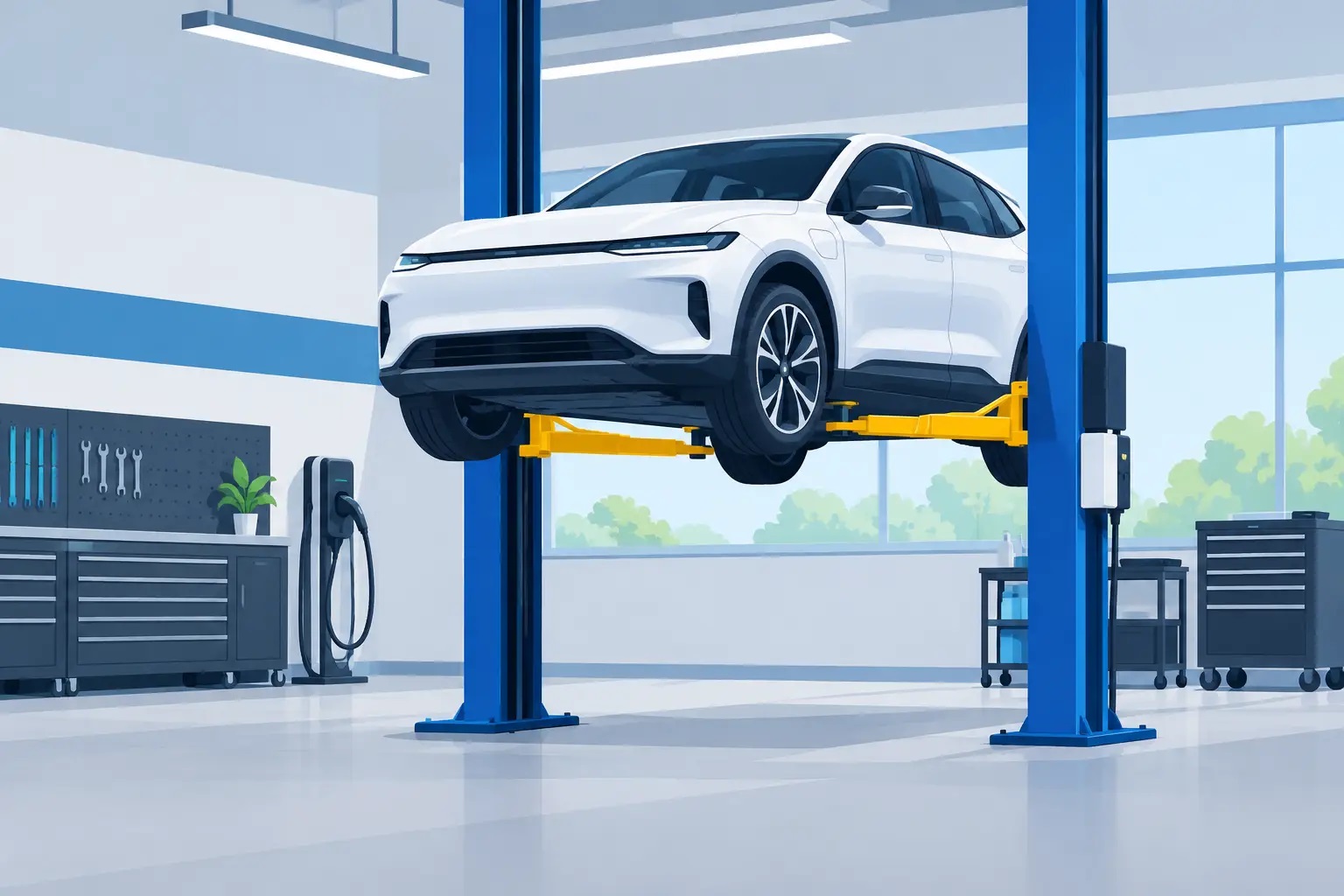
An EV may look like a routine lift job until the technician needs access around a large battery pack, reinforced lift points, underbody shields, and high-voltage components. Electric vehicle lifts do not always require a completely different lift design, but they do require a more disciplined approach to lift selection, arm setup, adapter choice, and shop workflow. A lift that works well for gas-powered sedans may still be the wrong long-term choice for a growing EV service department.
For repair shops, fleet operations, dealerships, and serious home garages, the goal is not simply to get an EV off the floor. The goal is to raise it safely, protect the vehicle, give the technician workable access, and avoid buying equipment that becomes a bottleneck as vehicle sizes and repair work change.
What Makes Electric Vehicle Lifting Different?
The battery is the central issue. Most EV battery packs are mounted low in the chassis, adding substantial weight near the center of the vehicle while taking up much of the underbody area technicians need to inspect or remove. That affects vehicle weight, lifting-point access, and the type of support equipment needed once the vehicle is in the air.
Many electric vehicles also use specific reinforced jack points, sometimes covered by trim panels or located farther inboard than expected. Lifting under the battery enclosure, rocker panels, aerodynamic shields, or suspension components not designated by the manufacturer can cause expensive damage. The correct lift must let technicians position arms and pads exactly where the vehicle manufacturer specifies.
Service work matters just as much as vehicle weight. Tire rotation, brake service, suspension repairs, and inspections can be handled on many conventional lifts. Battery removal, however, changes the equation. A shop performing battery-pack work needs unobstructed access below the vehicle and a properly rated battery table, lifting cart, or support system designed to lower and control a heavy pack safely.
Choosing Electric Vehicle Lifts by Shop Work
A two-post lift is often the most versatile choice for general EV repair. It provides wheel-free access for brake, tire, suspension, and underbody work while keeping the center of the vehicle accessible. For a mixed repair shop, a properly configured two-post lift can handle both internal-combustion and electric vehicles without dedicating a bay to one vehicle type.
The details of the two-post configuration matter. Symmetric and asymmetric arm layouts affect door clearance, vehicle positioning, and reach to lifting points. Low-profile arms and a wide range of telescoping arm positions are especially useful when the shop sees compact EVs, long-wheelbase crossovers, and full-size electric pickups in the same week. Check the lift's minimum and maximum arm spread against the vehicles you actually service, not just the vehicles in your parking lot today.
Four-post lifts are a strong option for inspections, alignment work, storage, and drive-on convenience. They are often preferred where technicians need to move vehicles through quickly or where a customer wants a lift that doubles as parking storage. For full wheel service or underbody repairs, plan for rolling jacks or jack platforms with sufficient capacity. A four-post lift can be highly productive, but it may not offer the same open-center access needed for battery work.
Scissor lifts can be a practical fit for quick service, tire work, and facilities with limited space. Full-rise models can provide useful undercar access, while low-rise and mid-rise units are well suited to certain service operations. The trade-off is access. Depending on the platform layout and lifting method, a scissor lift may interfere with the work area below an EV or make battery removal less convenient.
For heavy electric trucks, vans, transit vehicles, and commercial fleets, capacity should be treated as a planning decision rather than a minimum requirement. Heavy-duty two-post, four-post, runway, mobile column, and in-ground lift systems may all be appropriate depending on axle loads, wheelbase, vehicle height, and bay layout. Electric commercial vehicles can be significantly heavier than their gasoline counterparts, especially once cargo, upfits, tools, or passengers are included.
Capacity Is More Than the Vehicle's Curb Weight
A lift should never be selected solely because its published rating is slightly above a vehicle's curb weight. Shop owners need operating margin for heavier trim levels, fleet equipment, cargo, and future vehicle changes. A 10,000-pound lift may be a practical standard for many passenger vehicles and light trucks, but that does not automatically make it the right answer for every electric pickup or delivery van.
Consider the heaviest vehicles expected in the bay, including gross vehicle weight where applicable. Then consider how the load is carried. Lift arms, adapters, runways, rolling jacks, and auxiliary equipment all have their own ratings and operating limitations. The lowest-rated component in the setup controls the safe working capacity.
Technicians must also follow the lift manufacturer's vehicle-positioning instructions. An EV's low center of gravity can create a false sense of security, but improper arm placement remains dangerous. Before raising any vehicle, verify the OEM lift points, confirm pad contact, raise the vehicle slightly, and perform a stability check before going to working height.
Pads, Adapters, and Arm Reach Matter
A set of quality adapters can be the difference between a clean setup and a damaged underbody. EV-specific or pinch-weld adapters can help clear battery shields and body trim while reaching approved contact points. Rubber pads, height extensions, and slotted adapters may also be needed for vehicles with unusual rocker profiles or recessed lift pads.
Do not assume one adapter fits every EV. Tesla, Ford, GM, Rivian, Hyundai, Kia, Volkswagen, Nissan, and other manufacturers can use different lift-point locations and pad designs across models. Keep a current vehicle lifting-point reference available in the shop, and inspect adapters regularly for cuts, crushing, missing rubber, or deformation.
Arm reach deserves the same attention. Long wheelbase vehicles may need longer arms, while some smaller EVs have lift points positioned inboard enough to challenge conventional arm geometry. A lift that reaches the front points easily but forces a compromised rear-arm angle is not a good fit.
Plan for Battery Service Before You Need It
If your operation expects to perform battery removal or replacement, build the bay around that job instead of treating it as an accessory purchase later. The vehicle lift needs to provide clear access below the battery tray. The battery support equipment needs enough capacity, lifting range, deck size, and lateral adjustment to support the pack safely during removal and installation.
Battery packs are not always flat, centered, or evenly balanced. They may require controlled lowering, slight tilting, and precise repositioning during installation. A basic transmission jack is not a substitute for a properly rated EV battery table when handling a large traction battery.
Also account for the work around the lift. A battery table needs room to roll in and out, turn, and be staged safely. Shops should review bay width, door locations, overhead obstructions, floor transitions, and nearby workstations before purchasing equipment. A lift bay that is technically large enough can still be inefficient if technicians cannot maneuver support equipment around it.
Installation Requirements Still Control the Purchase
Electric vehicle service does not change the need for proper lift installation. Concrete thickness, compressive strength, slab condition, anchoring requirements, ceiling height, electrical supply, and bay dimensions must match the specific lift model. Never generalize one manufacturer's concrete requirement to another lift, even when the rated capacity appears similar.
For two-post lifts, inspect the slab for cracks, patches, slope, post-tension conditions, and hidden utilities before planning anchors. For four-post and scissor lifts, account for runway length, approach ramps, overall footprint, and service clearance. Low-ceiling shops may need a low-rise or low-ceiling lift design, but reduced rise height can limit battery-service access.
A good equipment plan also considers vehicle flow. Leave enough space for doors to open, technicians to work around the vehicle, carts to pass, and a second technician to assist when needed. If the lift will be used for alignment, calibrations, or ADAS-related work, the surrounding bay must support that process too.
Safety Procedures Cannot Be an Afterthought
The lift itself is only part of EV safety. Technicians need training on manufacturer lifting points, high-voltage system precautions, and the correct process for the repair being performed. A lift does not make a battery pack safe to service, and a raised EV is still a high-voltage vehicle until the required isolation procedures are completed.
Set a repeatable process for confirming vehicle weight, locating approved contact points, selecting adapters, checking arm locks, and verifying stability. Inspect lift pads, cables, chains, hydraulic components, locks, anchors, and safety devices on the schedule required by the equipment manufacturer. Keep the lift area clear, and do not allow battery handling equipment to exceed its rated load or travel range.
For shops adding EV work for the first time, My Tool Equipment Guy can help narrow the lift category, capacity range, and installation considerations before equipment is ordered. That conversation is most useful when it starts with the vehicles you service, the work you expect to perform, and the dimensions of the actual bay.
The best lift for EV work is rarely the one with the most features on paper. It is the one that reaches the approved lift points, carries your real vehicle mix with margin, gives technicians access to the repair, and fits the building without compromising safety or throughput.
Recent Posts
-

Electric Vehicle Lifts: What Shops Need to Know
Electric Vehicle Lifts: What Shops Need to Know An EV may look like a routine lift job until the te …21st Oct 2026 -
AMGO Hydraulics GLOBAL MANUFACTURER FOR AUTOMOTIVE LIFTS AND HYDRAULICS
AMGO HydraulicsGLOBAL MANUFACTURER FOR AUTOMOTIVE LIFTS AND HYDRAULICS AMGO Hydraulic Corporation h …20th Oct 2026 -
Automotive Lift Anchor Guide for Safe Installs
Automotive Lift Anchor Guide for Safe Installs A lift can have the right capacity, the right arm c …19th Oct 2026