
Best Lifts for Low Ceilings That Fit Your Shop
Best Lifts for Low Ceilings That Fit Your Shop
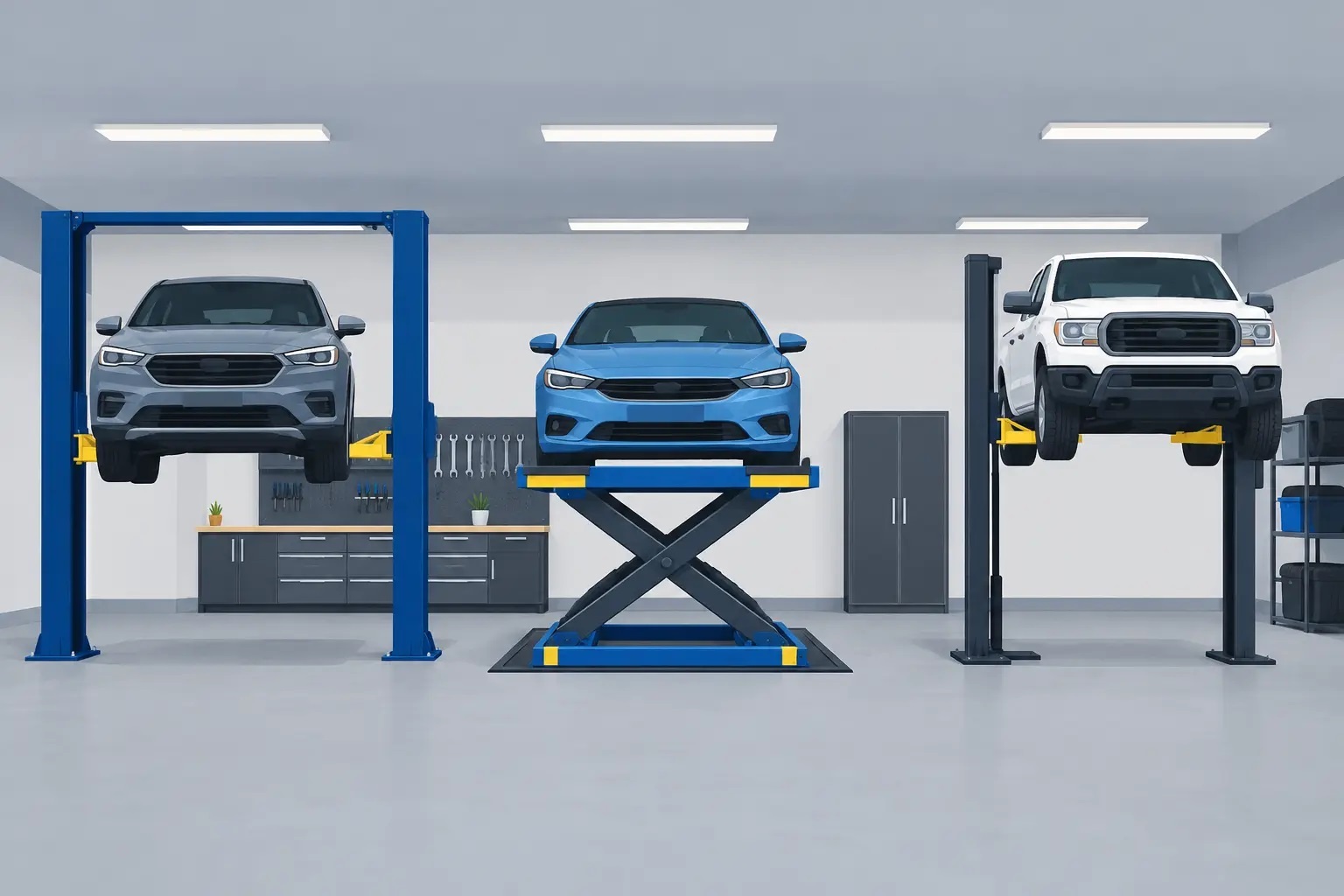
A lift that physically fits under the roof can still be the wrong lift for the job. The best lifts for low ceilings preserve enough working height to make brake, suspension, tire, and undercar service profitable without putting vehicle clearance, technician safety, or installation requirements at risk. In a short building, every inch matters - from the slab to the bottom of the lights, door tracks, sprinklers, and steel trusses.
For many shops and home garages, a low ceiling does not eliminate the possibility of owning a vehicle lift. It changes the selection process. The goal is not simply to buy the shortest model available. It is to match lift design, vehicle mix, required working access, and available clear height before the equipment is delivered.
Start With the Actual Clear Height
Do not plan from the advertised building height. Measure the lowest fixed obstruction in the lift bay. A 12-foot ceiling may have a 10-foot-8-inch clearance under a garage-door track, HVAC duct, light fixture, fire sprinkler line, or structural beam. That lowest point is the number that controls your installation options.
Measure at the exact planned lift location, not at the center of the room. Check the full length and width of the bay, because roof pitch and obstructions can change from one side of the lift to the other. Also account for the lift's power unit, overhead shutoff bar where applicable, and any vehicle roof accessories. Roof racks, ladder racks, light bars, antennas, and tall van bodies reduce usable clearance quickly.
There are three different dimensions buyers often mix together: ceiling clearance, overall lift height, and maximum lifting height. A lift may have short columns but still raise a vehicle high enough to contact the ceiling. Conversely, a model with taller posts may require more building height even if its maximum rise is modest. Review all three dimensions on the manufacturer specification sheet.
Best Lifts for Low Ceilings by Shop Use
The right low-ceiling lift depends largely on whether you need full undercar access, wheel service, storage, or a flexible general-repair bay.
Low-rise and mid-rise scissor lifts
Low-rise and mid-rise scissor lifts are often the practical answer for very short ceilings. Because they sit close to the floor when lowered and do not use tall posts, they avoid the vertical footprint of a conventional two-post or four-post lift. They work well for tire service, brake work, suspension repairs, detailing, inspections, and general maintenance.
The trade-off is working height. A low-rise unit typically raises the vehicle enough for wheels-off service but not for a technician to stand comfortably underneath. Mid-rise scissor lifts provide more elevation and can be a strong fit for shops with ceilings that rule out full-rise post lifts. They are also useful in bays where a raised vehicle must still clear door hardware or overhead utilities.
Scissor lift designs vary considerably. Some support vehicles by their tires on runways, while others use lifting pads or frame-contact platforms. Decide whether your work requires wheels to hang free, whether you service low-clearance vehicles, and whether open-center access is important. A scissor lift that is excellent for tires may be less efficient for exhaust or transmission work.
Short-column two-post lifts
A low-ceiling or short-column two-post lift is often the best option when full undercarriage access is the priority. For independent repair shops, these lifts can provide a much better service position than a scissor lift while fitting buildings where standard-height columns would not.
Two-post lifts generally offer open access to tires, brakes, suspension, driveline components, and underbody areas. They also use less floor space than a four-post runway lift. For a mixed fleet of sedans, pickups, SUVs, and light-duty commercial vehicles, that flexibility can make a short-column two-post lift a high-value investment.
The compromise is reduced rise. If the vehicle cannot go high enough for a standing technician, the benefit of full undercar access may be partly lost. That does not make the lift unsuitable. It means the shop should be honest about its primary work mix. A technician on a rolling seat can perform many jobs efficiently at a lower elevation, but transmission replacement and long-duration undercar repairs may demand more clearance than the building allows.
Pay close attention to the lift's arm configuration, minimum pad height, maximum pad spread, and asymmetric or symmetric loading design. Low sports cars need low-profile arms and pad heights. Long-wheelbase trucks may need arm reach and lifting capacity that compact low-ceiling models do not provide.
Four-post and parking lifts
Four-post lifts can be a good solution for vehicle storage, collector garages, inspections, alignment-related work, and some service operations. They support the vehicle by the tires, making drive-on loading straightforward for many users. In a low building, however, their runways and approach ramps need careful planning because the vehicle starts higher before it rises.
For storage, calculate stacked-vehicle clearance rather than lift clearance alone. The roof of the lower vehicle, the lowest point of the upper vehicle, and the lift's safety-lock positions all matter. A four-post lift can work in a low-ceiling building for compact cars, but it may not be practical for a tall SUV or pickup above another vehicle.
If you need wheels-free service from a four-post lift, add the height of any rolling jack or bridge jack to the equation. The vehicle rises above the runway before the wheels hang free, which further reduces clearance to the ceiling. This is one reason a four-post model that looks ideal for storage may be less suitable for full mechanical service in a short bay.
How Much Ceiling Height Do You Need?
There is no single safe ceiling-height number for every lift. Capacity, vehicle dimensions, lift geometry, arm style, and required working position all affect the answer. A low-ceiling two-post lift may be designed for buildings around 10 to 12 feet, while standard two-post models often require substantially more. Mid-rise scissor lifts can work in tighter spaces, but their useful service height is lower.
Instead of starting with a general rule, work backward from your tallest regular vehicle. Measure its overall height, then decide how much clearance you need above it at full lift height. Leave room for normal suspension movement, loading variation, roof accessories, and the possibility that a future customer drives in with a taller vehicle than expected.
A good planning question is: what job must this bay perform at its most demanding? If the answer is oil changes, tire rotations, brake jobs, and inspections, a mid-rise scissor lift may be enough. If the answer is daily diagnostic and mechanical work on a broad vehicle mix, a short-column two-post lift may justify any extra building modifications needed to use it properly.
Do Not Ignore the Floor and Installation Plan
Low ceilings get the attention, but the slab is just as important. Two-post lifts place concentrated loads at their columns and require concrete that meets the lift manufacturer's stated thickness, strength, condition, and anchoring requirements. A worn, cracked, patched, or unknown slab should be evaluated before installation.
Do not assume a thick-looking floor is suitable. Reinforcement, concrete strength, curing condition, expansion joints, existing cracks, and the location of in-floor heat or utilities can affect whether a lift can be safely anchored. Four-post lifts may have different anchoring needs depending on the model and use, while portable and scissor lifts have their own floor-flatness and surface requirements.
Electrical supply is another early check. Confirm voltage, phase, breaker requirements, and the planned power-unit location. Plan vehicle approach paths as well. A short bay can make a lift fit on paper while leaving poor room to open doors, swing long arms, move tool carts, or load a vehicle without repeated repositioning.
Compare the Specifications That Matter Most
When comparing the best lifts for low ceilings, look beyond the headline capacity. A 9,000-pound or 10,000-pound rating does not tell you whether the lift fits your vehicles or your building. Review the overall column height, maximum lift height, lowered height, pad or runway height, inside-column width, drive-through clearance, arm reach, and minimum arm clearance.
For scissor lifts, compare platform dimensions, lifting-point range, open-center design, wheel-free capability, and whether the unit is surface-mounted or requires recessing. For four-post lifts, review runway width, runway length, overall width, ramp length, jack compatibility, and the available safety-lock positions.
Also consider certified lift options when they fit the application. Independent third-party certification can be a purchase requirement for some commercial facilities, insurers, local jurisdictions, or corporate service operations. Verify the exact model configuration rather than assuming every version of a product line carries the same certification.
Make the Bay Work Before You Buy
A low-ceiling lift should improve throughput, not create a permanent compromise that slows every repair. Mark the proposed footprint on the floor, then park representative vehicles in the bay. Open the doors. Check arm swing or runway alignment. Measure from the highest point of the vehicle to the lowest overhead obstruction at the lift's planned raised position.
For new shop builds, a targeted roof modification, relocated door track, or better placement of lights and utilities can sometimes create enough clear height for a more productive lift. That cost should be compared against years of limited service access. In an existing home garage, a mid-rise lift may be the smarter decision when structural changes are not realistic.
MyToolEquipmentGuy.com has served the industry since 1984, and the practical lesson remains the same: select the lift around the bay, the vehicles, and the work you bill every day. A properly matched low-ceiling lift can turn restricted space into a dependable service bay without asking your technicians to work around avoidable limitations.
Recent Posts
-
Best Lifts for Low Ceilings That Fit Your Shop
Best Lifts for Low Ceilings That Fit Your Shop A lift that physically fits under the roof can still …21st Sep 2026 -
Best Tire Changers for Shops Worth Buying
Best Tire Changers for Shops Worth Buying A tire machine that struggles with a 20-inch low-profile …19th Sep 2026 -
Are Two-Post Lifts Safe? What Shops Need to Know
Are Two-Post Lifts Safe? What Shops Need to Know A two-post lift can put a 7,000-pound pickup high …17th Sep 2026