
A Practical Guide to Vehicle Lift Adapters
A Practical Guide to Vehicle Lift Adapters
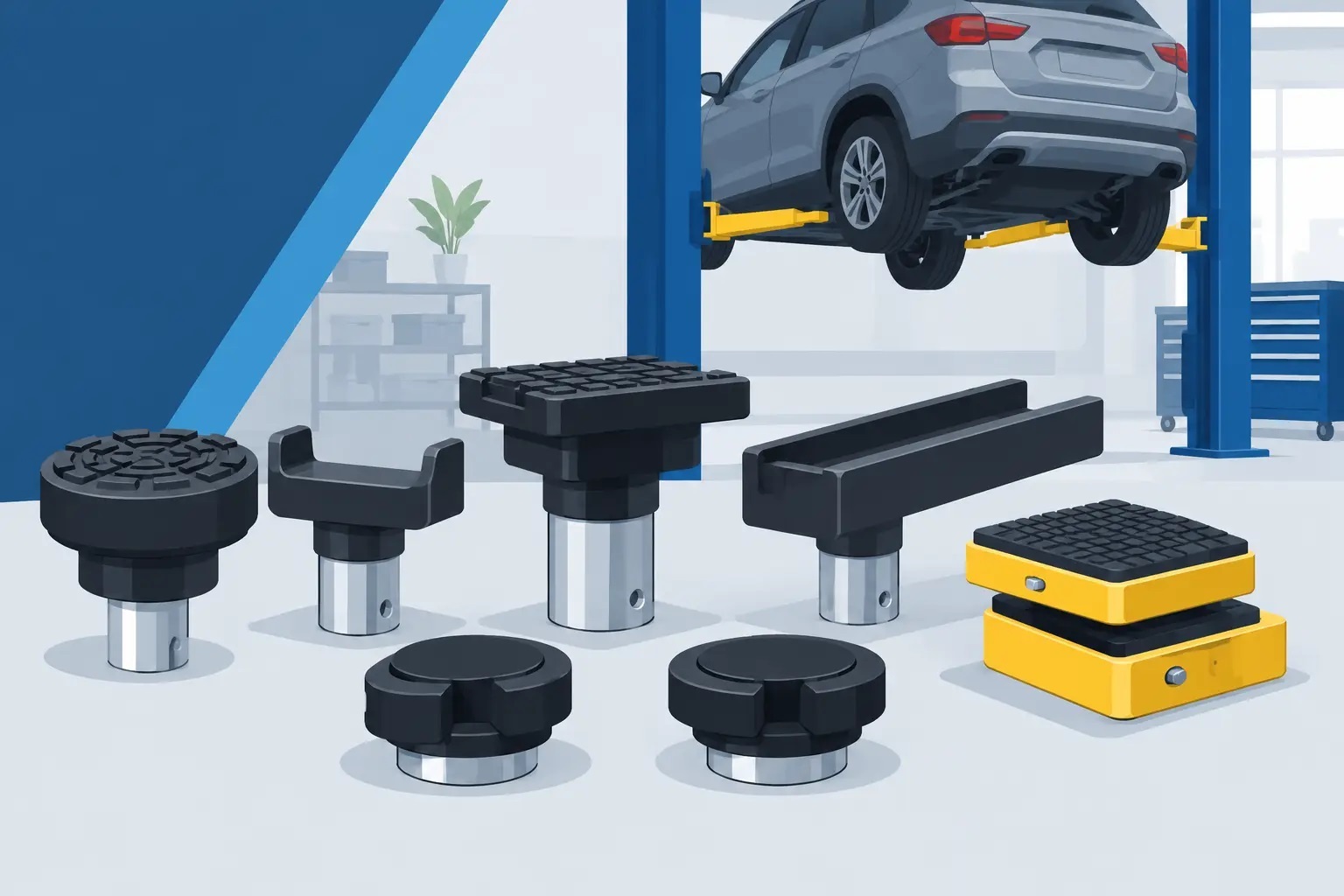
A lift can have the right rated capacity and still be the wrong setup for the vehicle in the bay. That is where this guide to vehicle lift adapters matters. The adapter is the contact point between the lift and the vehicle, and the wrong contact point can damage pinch welds, crush rocker panels, slip off a frame rail, or create an unstable load before the wheels leave the floor.
For professional shops, adapters are not minor accessories. They are part of the lifting system. The best choice depends on the lift style, vehicle lift points, underbody clearance, vehicle weight, and the type of work being performed. A quick-lube operation lifting late-model passenger cars has different needs than a fleet shop servicing service bodies, transit vans, and medium-duty trucks.
Why Vehicle Lift Adapters Matter
Most modern vehicles do not present a flat, open frame rail that can safely sit on a standard round lift pad. Unibody cars commonly use reinforced pinch-weld locations. SUVs may have recessed lift points, plastic rocker trim, or uneven frame sections. EVs add another concern: battery trays, high-voltage cable routing, and manufacturer-specified lifting areas that cannot be guessed.
A properly selected adapter gives the lift pad a stable, intended surface to support. It can add height, narrow the contact area, spread the load, or reach past body cladding to a factory lift point. It should do that without compromising the lift's mechanical limits or changing the vehicle's center of gravity beyond what the lift can safely handle.
The key point is simple: an adapter does not increase lift capacity. A 10,000-lb. two-post lift remains a 10,000-lb. lift, regardless of whether tall truck adapters or specialty frame pads are installed. The vehicle, the lift, each arm, the adapter set, and the contact method must all be suitable for the job.
Guide to Vehicle Lift Adapters by Application
Standard rubber pad adapters
Rubber pad adapters are the everyday choice for many two-post lifts. They protect painted or coated surfaces better than bare steel pads and provide a small amount of grip at approved lifting points. They work well on vehicles with accessible reinforced pinch welds or designated frame pads.
Their limitation is reach. A short rubber pad may not clear deep rocker panels, side steps, or underbody covers. It may also be too broad for a narrow pinch weld. Do not use a standard pad as a universal answer simply because it fits the arm. Verify the contact surface is large enough and structurally approved by the vehicle manufacturer.
Pinch-weld adapters
Pinch-weld adapters use a slotted or channel-shaped rubber block that captures the reinforced seam rather than resting against the rocker panel. They are common in general repair shops that service late-model cars, crossovers, and smaller SUVs.
The slot needs to match the seam width and the adapter height needs to clear adjacent trim. A slot that is too narrow can pinch or deform the seam. A slot that is too wide can allow the vehicle to shift. Inspect the rubber regularly because torn channels, hardened material, and missing pad sections reduce support and can mark the vehicle.
Tall and truck adapters
Tall adapters are used when standard two-post lift pads cannot reach the proper lifting point without placing the lift arms at a poor angle. This is common with pickups, lifted vehicles, full-size SUVs, vans, and certain body-on-frame vehicles. Taller adapters can also improve arm clearance around running boards and wide rocker panels.
Height solves one problem but can introduce another. Raising the contact point changes the vehicle's position relative to the lift arms and may reduce clearance to the ceiling. It can also make a tall, narrow vehicle feel less settled while being raised. Use matched adapter heights at all four lifting points unless the lift manufacturer and vehicle procedure specifically call for another arrangement.
For trucks, look beyond height alone. Confirm the adapter engages a structural frame location, not a thin crossmember, fuel-tank shield, suspension component, or bed support. Fleet vehicles with upfits deserve extra attention because service bodies, auxiliary tanks, and added equipment can change vehicle weight distribution.
Frame cradle and axle adapters
Frame cradle adapters have shaped saddles designed to hold round or irregular frame sections more securely than a flat pad. They are useful for certain trucks, classic vehicles, and specialty chassis. Axle or differential adapters are more specialized and should be used only where the lift manufacturer and vehicle lifting procedure allow them.
These adapters can be effective in a heavy-duty environment, but they demand disciplined positioning. Supporting a vehicle by an axle housing may be appropriate for specific service work, while supporting the same vehicle by a differential cover or suspension link is not. The intended repair also matters. If the technician needs the axle to hang free, an axle-supporting adapter may interfere with the job.
Low-profile and recessed-lift-point adapters
Low-profile cars bring the opposite problem. The vehicle may be so close to the floor that standard arms or pads cannot slide underneath. Low-profile pads, reduced-height adapters, and carefully selected arm configurations can help, but the shop still needs sufficient clearance to position the arms without contacting side skirts or aerodynamic panels.
This is also where drive-on four-post lifts or low-rise and full-rise scissor lifts may be a better operating choice. A two-post lift with the right adapters can be excellent for undercar work, but it is not automatically the most efficient answer for every low vehicle in the service mix.
Match the Adapter to the Lift, Not Just the Vehicle
Before ordering an adapter, confirm how it mounts to the lift. Two-post lift pads use different pin diameters, receiver dimensions, thread styles, and pad assemblies depending on the manufacturer and model. An adapter that looks similar may not seat correctly, may have excessive play, or may prevent the arm from fully contacting its stop.
Use the lift manufacturer's approved adapter options whenever possible. If an aftermarket accessory is under consideration, verify its stated compatibility, capacity, construction, and retention method. A loose adapter is not a minor annoyance. It can move as the arms rise, especially when the vehicle is not perfectly level.
Four-post and runway lifts require a different approach. They may use jack bridge pads, rolling jack assemblies, wheel chocks, or specialty lifting blocks rather than swing-arm adapters. Scissor lifts may require rubber blocks, pad extensions, or vehicle-specific contact pads. Treat each lift design as its own system.
Check Capacity, Height, and Load Balance Together
Capacity labels should be read as a system of limits. The lift rating is only one number. The adapter's rating, the pad assembly, the arm rating, and any auxiliary jack capacity must also meet or exceed the load being supported. If an accessory is not clearly rated for the intended use, do not assume it is suitable because it is made of steel.
Vehicle balance is equally important. A front-heavy vehicle, a pickup with a loaded service body, or an EV with a large floor-mounted battery may not behave like a conventional sedan. Position the vehicle according to the lift and vehicle manufacturer's procedures, then raise it only far enough to verify pad engagement and stability before continuing.
A practical shop procedure is to stop after the tires clear the floor, check all four contact points, confirm the arms have not shifted, and give the vehicle a controlled stability check before lifting to working height. Once at height, lower the lift onto its mechanical safety locks. Hydraulic pressure is for lifting. The locks are for working.
Common Adapter Mistakes That Cost Shops Money
The most expensive mistakes are usually preventable. Technicians damage rocker panels when a flat pad misses the reinforced pinch weld. They bend lift arms or create an unstable setup by using stacked blocks to gain height. They lose time when an adapter set is stored across the shop instead of at the lift where it is needed.
Avoid improvising with wood blocks, loose steel plates, stacked rubber pucks, or adapters from another lift model. These workarounds can split, slide, or load the arm in a way the equipment was never designed to handle. If a vehicle requires more height or a different contact shape, use a purpose-built, rated accessory.
Adapter condition deserves a scheduled inspection. Check rubber pads for cuts and compression, steel components for cracks or bent sections, retaining pins for wear, and threaded components for damage. Replace parts that no longer fit securely. The cost of fresh pads is small compared with one rocker-panel claim or one unsafe lift event.
Build an Adapter Set Around Your Actual Car Count
A general repair shop usually benefits from a core set of standard rubber pads, pinch-weld blocks, and tall adapters for trucks and SUVs. A shop focused on trucks, fleets, or off-road vehicles may need deeper frame cradles and multiple tall-adapter heights. European, exotic, and EV-heavy service departments may need vehicle-specific pad systems and updated manufacturer lift-point information.
Do not buy adapters as an afterthought when selecting a lift. Include them in the equipment plan, along with ceiling height, concrete requirements, bay width, arm style, and the heaviest vehicles the shop expects to service. MyToolEquipmentGuy.com has served the industry since 1984, and the same buying principle still applies: the right lift setup is the one that fits the vehicles coming through your doors, not just the vehicle you lifted last week.
The best adapter set makes correct lifting the easy choice. When technicians can reach approved lift points quickly, protect the vehicle, and lock the load down with confidence, the bay stays productive and the shop avoids preventable damage.
Recent Posts
-
A Practical Guide to Vehicle Lift Adapters
A Practical Guide to Vehicle Lift Adapters A lift can have the right rated capacity and still be th …9th Oct 2026 -
Flush Mount Lifts for Productive Service Bays
Flush Mount Lifts for Productive Service Bays A bay with a lift sitting above the slab has a perman …7th Oct 2026 -
Symmetric Versus Asymmetric Lifts for Your Shop
Symmetric Versus Asymmetric Lifts for Your Shop A two-post lift can look like a simple purchase unt …7th Oct 2026