
Flush Mount Lifts for Productive Service Bays
Flush Mount Lifts for Productive Service Bays
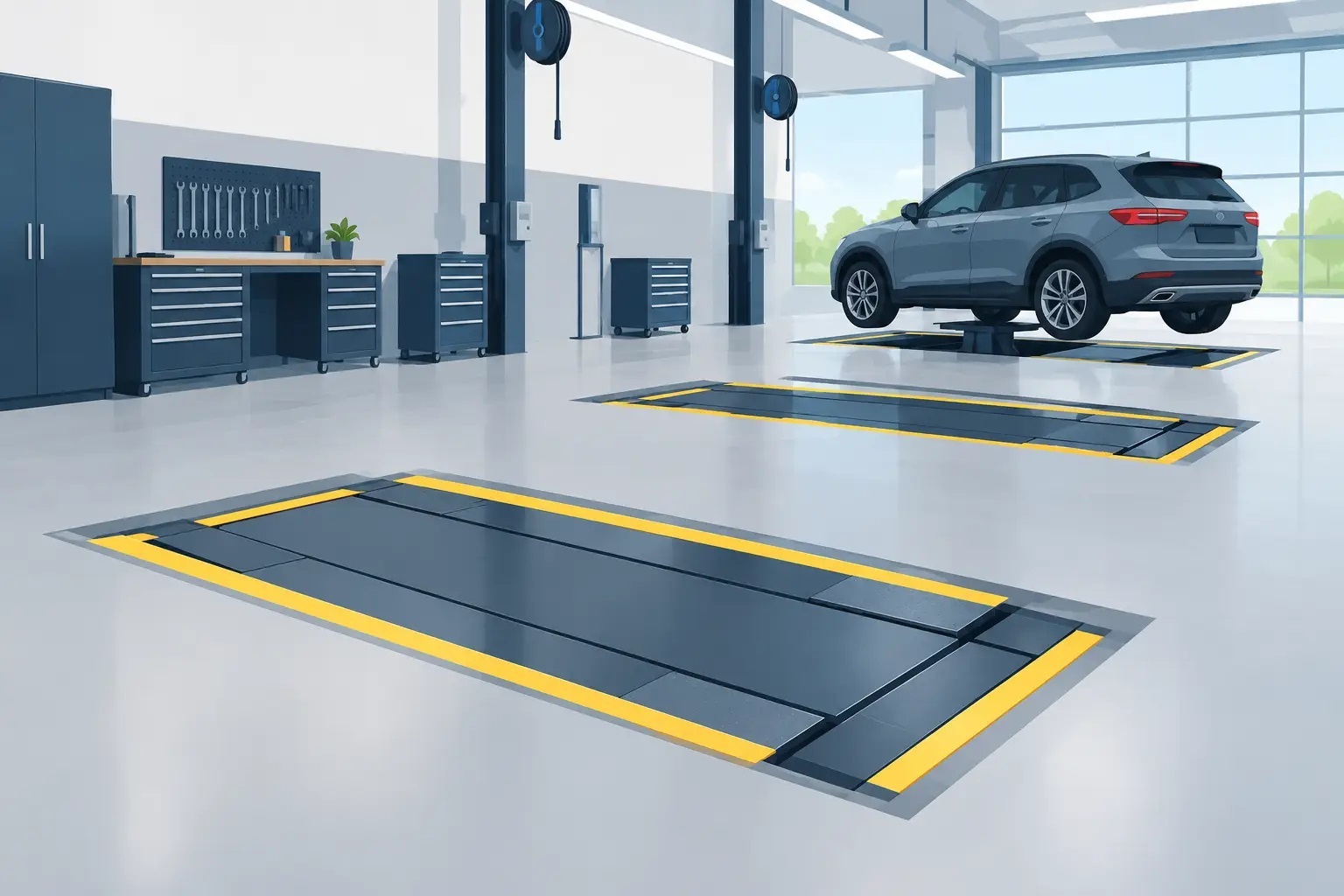
A bay with a lift sitting above the slab has a permanent footprint. A bay with flush mount lifts can return to a flat, usable floor when the lift is fully lowered. That difference matters in crowded repair shops, detail operations, alignment areas, and multipurpose service bays where every square foot has to earn its keep.
Flush-mounted equipment is not a shortcut installation. It requires more up-front planning than a surface-mounted lift, particularly around excavation, reinforced concrete, drainage, power, and final floor elevation. Done correctly, it can create one of the cleanest and most flexible lift bays in a facility.
What Are Flush Mount Lifts?
Flush mount lifts are vehicle lifts installed in a recessed concrete pocket so their runways, platforms, or lifting structure sit at floor level when lowered. Most commonly, the term refers to recessed scissor lifts, including low-rise, mid-rise, full-rise, alignment, and frame-contact models. Some in-ground lift systems can also be installed with components below floor level, but they are a different equipment category with their own construction requirements.
The practical benefit is simple: technicians can drive over the lowered lift without ramps, and the bay remains usable for other work when no vehicle is raised. A flush installation also removes the trip hazards and vehicle-clearance concerns that can come with surface-mounted scissor lifts.
That does not automatically make recessed equipment the right answer for every shop. A two-post lift may provide better undercar access for general mechanical work. A four-post lift may be the stronger choice for drive-on service, storage, or certain alignment applications. Flush mounting is most valuable when floor access, bay flexibility, and a clean working environment outweigh the added construction cost.
Where a Flush-Mounted Lift Makes Sense
A recessed scissor lift is a strong fit for tire and wheel service, inspections, quick mechanical work, detailing, ADAS-related work that needs an open bay, and alignment service when paired with the proper alignment configuration. Collision shops often value the unobstructed floor because vehicles, carts, frame equipment, and body panels move through the area constantly.
For a general repair shop, the decision often comes down to the type of work performed most often. If technicians regularly need free access around the sides of a vehicle and want no posts in the way, a flush-mounted scissor lift can work well. If they spend most of the day removing transmissions, exhaust systems, fuel tanks, or driveline components, compare the under-vehicle access carefully against a two-post lift before committing.
Home-garage buyers should be equally realistic. The finished appearance is excellent, but a recessed lift is rarely a simple weekend project. New construction is the ideal time to plan one because the excavation, plumbing considerations, and reinforcing can be built into the slab design from the start.
Concrete Work Is the Deciding Factor
The lift itself is only part of the purchase. Flush mount lifts depend on the recessed foundation being built to the lift manufacturer's exact drawings. Pocket length, width, depth, wall thickness, rebar layout, concrete strength, and anchor locations are not interchangeable from one model to another.
Do not assume an existing shop slab can simply be cut and lowered. Before concrete is removed, verify the slab thickness, reinforcing, underground utilities, plumbing, radiant heat lines, and soil conditions. A qualified contractor should review the manufacturer’s installation documents and local building requirements before work begins.
The finished pocket must also be level and square. If the recess is out of tolerance, lift platforms may not sit flush, vehicles may not track straight onto the lift, and the installation can become expensive to correct after the fact. It is far less costly to confirm dimensions during layout than to rebuild concrete after equipment arrives.
Drainage Cannot Be an Afterthought
A recessed lift pocket collects what falls into it: water, salt, oil residue, dirt, brake dust, and road debris. Without a drainage plan, that material can hold moisture against lift components and create a difficult cleanup problem.
Many installations use a drain system, sump, or other approved method to manage water. The right approach depends on the lift design, local code, wastewater rules, and whether the shop is handling oils or other vehicle fluids. The key point is to plan drainage before the pour, not after water has already started collecting below the platforms.
Good housekeeping still matters. Technicians should keep the recess clear, inspect hoses and moving parts as required by the manufacturer, and clean out debris before it interferes with lift operation or safety devices.
Plan Utilities Before the Slab Is Finished
Most flush-mounted lifts require electrical service routed to a specified location. Some models may require air for pneumatic safety locks or other functions. Alignment lifts may add requirements for lighting, console placement, turnplates, slip plates, and space for an alignment system.
Coordinate conduit, disconnects, air lines, drains, and control locations with the lift layout. A clean bay should not end with a control pedestal placed where a technician cannot move a tool cart or open a vehicle door. The best installations account for the full workflow, not just the hole in the floor.
Choosing the Right Flush Mount Lift Configuration
Capacity is the first filter. Select a lift based on the heaviest vehicles the bay will routinely service, not the average passenger car that comes through the door. Include loaded fleet vans, extended SUVs, EVs with high curb weights, and the vehicles you expect to add as the business grows.
Low-rise flush lifts are useful where ceiling height is limited or where the goal is tire service, detailing, and undercar inspections rather than full standing-height access. Mid-rise units offer more working height but still suit facilities that need a low-profile floor. Full-rise scissor lifts can put a vehicle at productive service height while preserving a clear bay when lowered.
Alignment scissor lifts require more specific evaluation. A true alignment setup needs the correct runway length, wheelbase range, lift capacity, and provisions for turnplates and rear slip plates. A standard scissor lift may raise a vehicle, but it is not automatically an alignment lift. Buying the right configuration at the start avoids trying to retrofit precision equipment into a bay that was not designed for it.
Also look at lifting method. Frame-contact scissor lifts support the vehicle at designated lifting points and can leave wheels free for brake, tire, and suspension work. Drive-on runway styles support vehicles by the tires and are often better suited to inspection and alignment operations. Neither style wins in every service department. The job mix decides it.
Operating Clearance Still Matters
A lift may disappear into the floor, but the vehicle does not. Measure bay width, door clearance, technician walk paths, overhead lighting, ventilation drops, fire-suppression components, and ceiling obstructions before selecting a model. Full-rise capability is limited by the building’s clear height and the vehicles being raised.
For EV and hybrid service, confirm that the lift provides appropriate access for battery work and that the shop has a safe plan for battery removal equipment. The lift capacity alone does not answer that question. Platform spacing, underbody access, jack tray options, and the placement of support equipment all affect how useful the bay will be.
Budget Beyond the Lift Price
A surface-mounted lift generally has a lower installed cost because it avoids excavation and a recessed foundation. Flush mounting adds concrete work, possible drainage infrastructure, electrical routing, engineering review, and more coordination between the equipment supplier, contractor, and installer.
That added cost can be justified when the bay serves multiple purposes or when a low-profile floor directly improves workflow. A tire shop with limited space may gain usable staging area. A dealership may keep a premium service lane looking cleaner. A collision operation may avoid working around posts and ramps. But if the bay will perform dedicated general repair every day, a conventional two-post lift may deliver more access per dollar.
Request the lift’s foundation drawing early, then build the equipment, construction, freight, installation, and permitting costs into one project budget. This is especially important for new shops, where a small planning error can affect several trades and delay opening day.
Keep Safety and Serviceability in the Plan
A recessed lift should be installed and inspected according to the manufacturer’s instructions and applicable local requirements. Train operators on vehicle positioning, rated capacity, approved lift points, safety-lock engagement, and daily inspection procedures. Keep lift documentation in the shop, including service intervals and any required inspection records.
Serviceability deserves consideration too. Ask how technicians will access hydraulic lines, cylinders, locks, and electrical components. A flush floor looks clean, but the equipment below it still needs periodic attention. Choose a lift with a support path that makes sense for your location and workload.
For shop owners comparing lift styles, the most productive choice is not always the one with the lowest equipment price. It is the one that fits the vehicles, building, and revenue work planned for that bay. MyToolEquipmentGuy.com can help match the lift configuration to those requirements before concrete work turns a preliminary idea into a permanent layout.
Recent Posts
-
Flush Mount Lifts for Productive Service Bays
Flush Mount Lifts for Productive Service Bays A bay with a lift sitting above the slab has a perman …7th Oct 2026 -
Symmetric Versus Asymmetric Lifts for Your Shop
Symmetric Versus Asymmetric Lifts for Your Shop A two-post lift can look like a simple purchase unt …7th Oct 2026 -
Parking Lifts: Add Vehicle Storage Space
Parking Lifts: Add Vehicle Storage Space A full parking area is not always a sign that a business n …1st Oct 2026