
Symmetric Versus Asymmetric Lifts for Your Shop
Symmetric Versus Asymmetric Lifts for Your Shop
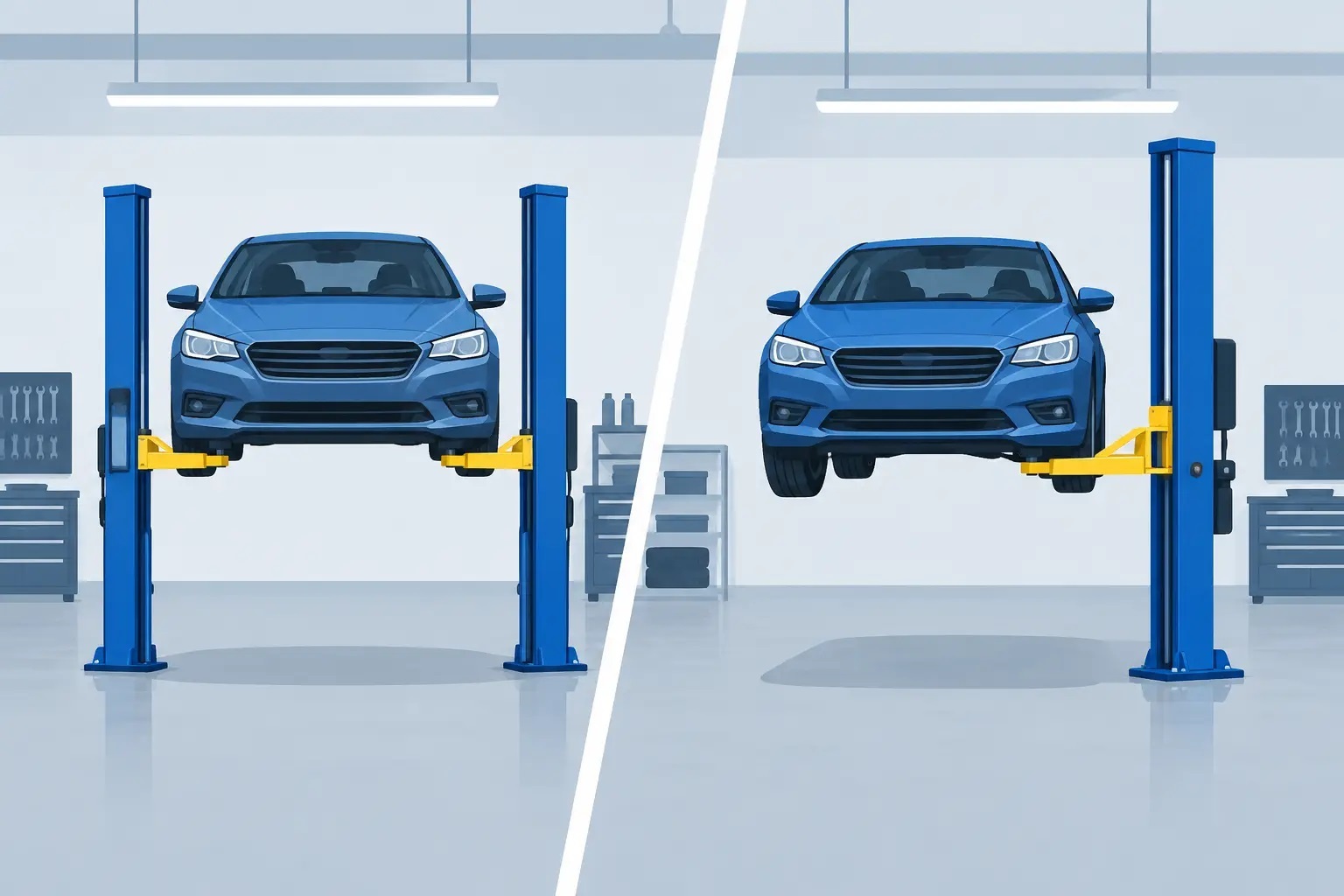
A two-post lift can look like a simple purchase until a vehicle is sitting six feet in the air and a technician needs room to open a door, reach a transmission, or remove a rear axle. The choice between symmetric versus asymmetric lifts affects how vehicles sit in the bay, how easily technicians enter and exit, and which mix of cars and trucks the lift handles best.
For many general repair shops, an asymmetric two-post lift is the practical default. That does not make it the right answer for every facility. Symmetric lifts still have a strong place in fleet work, truck service, and bays that routinely lift longer or heavier vehicles. The right choice comes down to vehicle mix, work type, bay dimensions, and how the lift will be used every day.
What makes a lift symmetric or asymmetric?
A symmetric two-post lift positions its columns directly across from one another, with the vehicle generally centered between them. The lift arms are typically the same length front to rear. When loaded correctly, the vehicle's center of gravity is centered between the columns.
An asymmetric lift uses a different geometry. Its columns may be rotated, often about 30 degrees, and its arms are arranged to position the vehicle farther back in the bay. Most asymmetric models use shorter front arms and longer rear arms. This lets the technician drive farther forward between the posts while keeping the vehicle's center of gravity in the proper lifting zone.
That design creates more clearance around the front doors on many passenger cars, crossovers, and light-duty pickups. A technician can often open the driver's door more easily after the vehicle is raised, which matters in a busy service department where getting in and out of vehicles is constant.
The terms can be confusing because some lifts offer a symmetrical loading capacity with asymmetrical columns or arms. Always review the manufacturer's vehicle-positioning instructions rather than relying on the product name alone. Arm configuration, column angle, and rated capacity all matter.
Symmetric versus asymmetric lifts: the working difference
The most noticeable difference is vehicle placement. On a symmetric lift, the vehicle is centered in the opening. This can require more careful positioning of longer vehicles and may leave the posts closer to the doors. For trucks, vans, and fleet vehicles, that centered layout can be a benefit because it provides balanced support with equal-length arms.
With an asymmetric lift, the vehicle sits farther back relative to the columns. The front doors are usually positioned ahead of the posts, creating better entry and exit room. That can save time on inspections, interior work, electrical diagnosis, and any repair that requires the technician to move repeatedly between the cabin and the service area.
Neither configuration automatically provides better stability. Stability comes from using the lift within its rated capacity, placing the arms at approved lifting points, engaging the arm restraints, and following the manufacturer's loading instructions. A poorly positioned vehicle is unsafe on either style of lift.
When an asymmetric lift makes sense
Asymmetric lifts are common in independent repair shops, quick-service facilities, dealership lanes, and general mechanical bays. They are particularly well suited to shops servicing a high percentage of sedans, compact SUVs, crossovers, and half-ton pickups.
The door-clearance advantage is real, but it is not the only reason to choose one. By allowing a vehicle to be driven farther forward, an asymmetric layout can make a standard two-post bay feel more usable. This is helpful when technicians work in tight spaces or when a shop wants efficient access around the vehicle without moving it repeatedly.
An asymmetric model is usually a strong fit when your work includes brakes, suspension, tires, exhaust, oil service, diagnostics, and general repair. It gives excellent undercar access while keeping the cabin more accessible than a traditional centered-post arrangement.
There are trade-offs. Very long-wheelbase vehicles, certain vans, and some heavy trucks may require more attention to arm reach and center-of-gravity placement. Before purchasing, compare the lift's minimum and maximum arm spread, pad height, drive-through width, overall height, and lifting-point coverage against the actual vehicles coming through your doors.
When a symmetric lift is the better tool
A symmetric lift is often the straightforward choice for shops with a steady diet of trucks, work vans, municipal vehicles, fleet units, and longer-wheelbase vehicles. Equal-length arms and a centered loading pattern can offer flexible reach when vehicle dimensions vary widely.
This configuration also works well for facilities that prioritize balanced positioning over front-door access. If your technicians spend most of their time under the vehicle rather than moving in and out of the driver's seat, the asymmetric door-opening benefit may carry less weight.
Capacity should be part of this decision. A 10,000-pound two-post lift is a common general-service rating, but capacity alone does not tell the whole story. A heavy electric vehicle, extended-cab truck, commercial van, or loaded fleet unit may need a higher-capacity lift and arms designed for its lifting points. Shops servicing 12,000-pound to 18,000-pound vehicles should evaluate heavy-duty two-post models, drive-on lifts, or other configurations built for the job.
A symmetric lift can be an efficient option for serious home garages as well. Owners with full-size pickups, classic vehicles, or mixed personal fleets may prefer the centered layout and broad arm coverage. The decision should still start with the longest and heaviest vehicle you expect to lift, not the smallest car currently in the garage.
Capacity, concrete, and ceiling height come first
Do not choose between symmetric and asymmetric designs before confirming that the building supports the lift. A two-post lift is a structural installation, not a piece of equipment that can be placed wherever there is open floor space.
Manufacturers specify minimum concrete thickness, compressive strength, cure time, and slab condition. Requirements vary by model and capacity. A typical existing shop slab is not automatically suitable, especially if it has unknown thickness, cracks, prior repairs, radiant heat tubing, or a post-tension system. Core sampling or a qualified site review may be necessary before drilling anchor holes.
Ceiling height is equally important. A lift with an overhead crossbar may need more vertical clearance than the raised roofline of the tallest vehicle you service. Low-ceiling two-post lifts are available, but reduced height can affect maximum lifting height and technician comfort underneath. Measure the bay carefully, including lights, heaters, sprinklers, doors, trusses, and obstructions above the proposed column locations.
Also plan for electrical service. Most commercial two-post lifts use a dedicated power supply, often 220-240 volt single-phase power, though specifications vary. Confirm voltage, phase, breaker requirements, and disconnect placement before delivery and installation.
Questions to answer before ordering
A lift purchase goes smoother when the equipment selection is based on real shop conditions rather than a general capacity number. Confirm these four points before committing to a model:
- The heaviest vehicle, longest wheelbase, widest track, and lowest ground-clearance vehicle the lift must handle.
- The slab thickness, concrete strength, condition, and clear area available for the columns and anchors.
- The ceiling height, electrical supply, bay width, and door clearance at the planned installation location.
- The service work performed most often, including whether technicians need frequent access to vehicle doors and interiors.
If your vehicle mix includes everything from compact cars to three-quarter-ton trucks, arm range deserves special attention. Adapters, truck pads, frame-engaging accessories, and low-profile arms can expand a lift's usefulness, but they must be compatible with the specific model. Do not assume accessories are interchangeable across brands or capacities.
Safe loading matters more than the label
Both lift styles depend on correct setup. Technicians should identify manufacturer-approved lifting points, position all four adapters securely, raise the vehicle slightly, and check for stable contact before continuing upward. Once at working height, the lift should be lowered onto its mechanical safety locks according to the manufacturer's procedure.
A lift should never be used to compensate for poor vehicle positioning, missing lift-point information, or an overloaded bay. Battery packs, cargo, aftermarket equipment, toolboxes, and uneven vehicle modifications can change weight distribution. This is especially relevant with EVs, service bodies, and fleet vehicles carrying mounted equipment.
For a new shop build or a high-ticket replacement, it pays to discuss your vehicle mix and building dimensions with an equipment specialist before placing the order. MyToolEquipmentGuy.com can help narrow the field by capacity, lift style, clearance requirements, and installation needs.
The best two-post lift is the one that lets your technicians position vehicles correctly, work efficiently, and use the bay with confidence every shift. Choose the configuration around the work you actually sell, then make sure the building is ready to support it.
Recent Posts
-
Flush Mount Lifts for Productive Service Bays
Flush Mount Lifts for Productive Service Bays A bay with a lift sitting above the slab has a perman …7th Oct 2026 -
Symmetric Versus Asymmetric Lifts for Your Shop
Symmetric Versus Asymmetric Lifts for Your Shop A two-post lift can look like a simple purchase unt …7th Oct 2026 -
Parking Lifts: Add Vehicle Storage Space
Parking Lifts: Add Vehicle Storage Space A full parking area is not always a sign that a business n …1st Oct 2026