
How to Choose a Vehicle Lift for Your Shop
How to Choose a Vehicle Lift for Your Shop
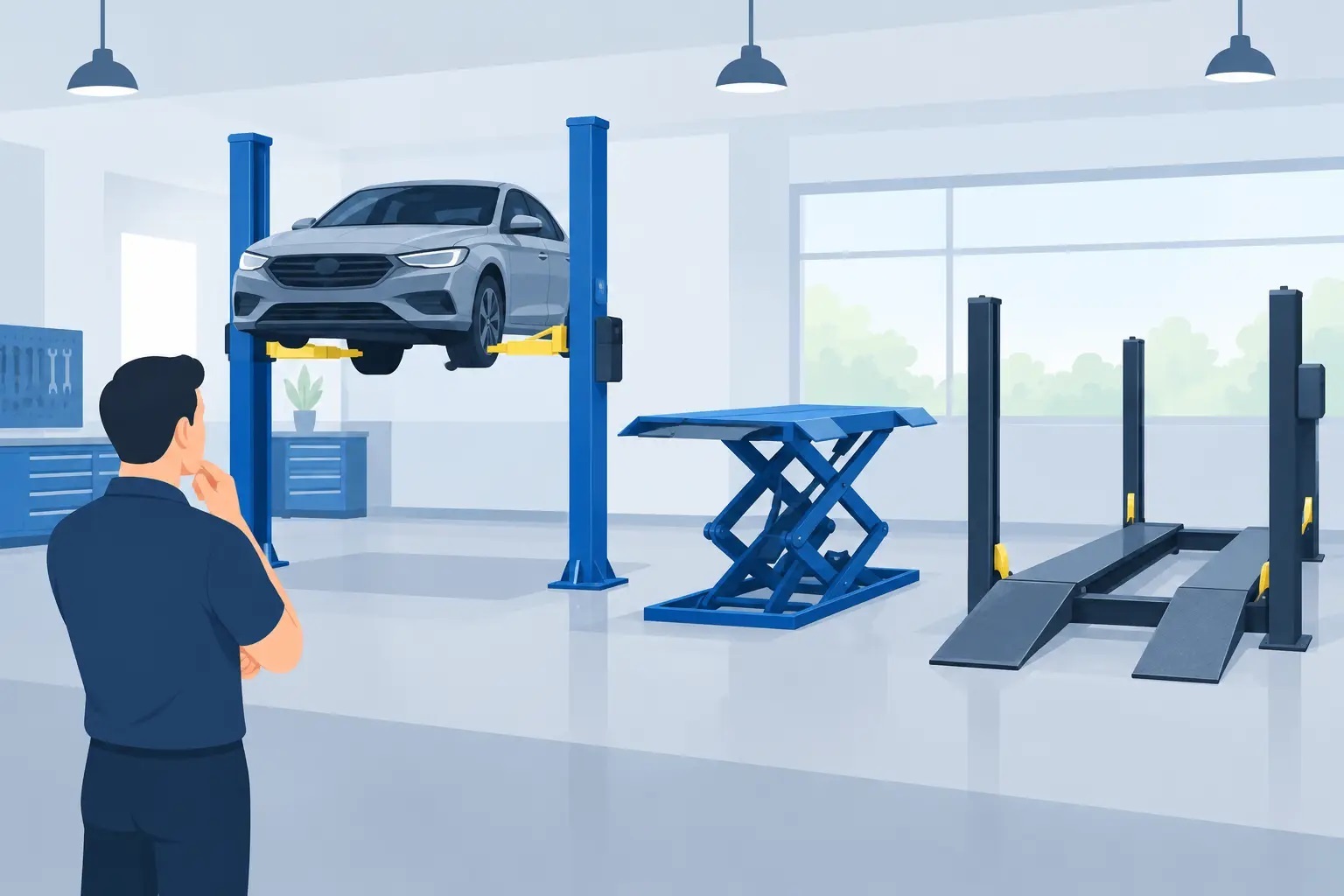
A lift that is undersized, poorly matched to your vehicle mix, or impossible to install in your building becomes an expensive bottleneck fast. Knowing how to choose a vehicle lift starts with the work you need it to do every day, then works backward through capacity, access, building conditions, and budget. The lowest-priced lift is not always the lowest-cost choice once lost bay time, installation changes, and future vehicle needs enter the picture.
How to Choose a Vehicle Lift Based on Daily Work
Start with the vehicles that will spend the most time in the bay, not the occasional vehicle you hope to service later. An independent repair shop handling sedans, SUVs, and half-ton pickups needs a different lift than a diesel shop working on long-wheelbase trucks, a tire store moving high volume, or a collector who mainly wants vehicle storage.
Write down the actual vehicle classes you service, their approximate curb weights, wheelbases, widths, and low-clearance concerns. Include EVs and hybrids if they are part of your market. Their battery placement, lifting-point requirements, and added weight can affect both capacity selection and the adapters you need.
Then define the work performed in that bay. General mechanical repair, tire and brake work, alignments, exhaust service, vehicle storage, detailing, and frame work all place different demands on the lift. A lift that provides excellent undercar access may not be the best choice for quick-drive tire service. A four-post lift that works well for storage may need additional equipment for wheel-free brake and suspension work.
Match Lift Capacity to the Real Load
Never select capacity by using the weight of your average vehicle alone. Account for the heaviest vehicles you expect to lift, how frequently they enter the shop, and whether your business is likely to move into heavier work. Capacity also needs to be considered with wheelbase, vehicle balance, arm reach, and available lifting points.
For many automotive repair shops, a 9,000- or 10,000-pound two-post lift is a practical starting point for passenger vehicles and light trucks. A 12,000-pound or 15,000-pound model may make more sense for a shop that routinely sees larger pickups, commercial vans, or loaded fleet vehicles. Heavy-duty truck lifts can range far beyond that, including configurations rated up to 99,000 pounds for serious fleet and commercial applications.
Do not assume a higher rating solves every problem. A heavier-capacity lift can require more floor space, larger columns, greater electrical requirements, and a stronger concrete slab. It may also cost more than the work justifies. The right capacity is the one that safely covers your regular workload while leaving reasonable room for growth.
Choose the Lift Style That Fits the Job
The main lift categories are built around different shop workflows. Selecting the right configuration matters as much as the posted capacity.
Two-post lifts for general repair
Two-post lifts are the standard choice for many repair bays because they provide open access to wheels, brakes, suspension, exhaust, and much of the undercarriage. Symmetric models position the vehicle more evenly between the columns, while asymmetric designs can place the vehicle farther back for better door clearance and access in tighter bays.
Two-post lifts are efficient for general service, but installation is not casual. They require adequate concrete thickness and strength, correct anchoring, proper overhead clearance, and careful attention to vehicle lifting points. Technicians also need to use the correct arm configuration and adapters for each vehicle.
Four-post lifts for service, alignment, and storage
Four-post lifts support vehicles on runways, making them a strong fit for alignment work, inspections, storage, and applications where drive-on convenience matters. They are popular with dealerships, tire shops, collectors, and facilities that want to stack vehicles for storage.
For repair work requiring wheels to hang free, plan for a rolling bridge jack or jack tray. Alignment-capable four-post lifts need the proper runway design, turn plates, slip plates, and alignment equipment. A standard four-post storage lift is not automatically an alignment rack.
Scissor lifts for low-profile bays and fast service
Scissor lifts are useful where ceiling height is limited or where a shop needs a compact lift for tires, brakes, quick service, body work, or vehicle inspections. Low-rise and mid-rise models are especially useful for shops that do not need full standing-height access beneath every vehicle.
The trade-off is access. A scissor structure can block portions of the vehicle underside, and some models are less suitable for extensive transmission, exhaust, or drivetrain work. Make sure the platform design and lifting height support the repairs you intend to perform.
Specialty lifts for specialized revenue
Motorcycle lifts, parking lifts, in-ground systems, mobile column lifts, heavy-duty runway lifts, and low-ceiling models solve specific problems that general-purpose equipment cannot. A motorcycle shop needs secure clamping and a workable deck height. A fleet operation may need mobile columns that can lift buses, box trucks, or other large vehicles without dedicating one fixed bay to each vehicle size.
Specialty equipment pays off when it matches a repeatable service need. Buying it for rare jobs can tie up capital that may be better spent on a more versatile lift or another high-use piece of shop equipment.
Measure the Building Before Ordering
A lift specification sheet cannot tell you whether it fits your facility unless you have accurate building measurements. Check ceiling height, bay width, bay depth, door tracks, lighting, HVAC ducts, sprinkler lines, roof structure, and any obstructions that could interfere with a raised vehicle.
For an overhead two-post lift, the combined height of the lift and the tallest vehicle at full rise must clear the ceiling and all overhead obstacles. Low-ceiling lift models can help in restricted spaces, but they may limit maximum lifting height. That is a reasonable trade-off for a home garage or a service area where full-height undercar work is not required.
Concrete deserves the same level of attention. Most anchored lifts have specific slab thickness, concrete strength, cure-time, and anchoring requirements. A cracked slab, unknown concrete thickness, embedded radiant tubing, or poor-quality concrete can stop an installation or create a serious safety issue. Do not guess. Verify the slab against the lift manufacturer’s requirements before delivery.
Also plan the electrical supply. Many lifts use 220V single-phase power, while larger commercial equipment may require three-phase service. Confirm voltage, amperage, disconnect requirements, and the location of the power unit before the installer arrives.
Consider Safety Features and Certification
A vehicle lift is productive equipment, but it is also a major suspended-load system. Look for equipment that is properly engineered for the intended application and review available third-party certification options, including ALI certification where applicable. Certification is not a substitute for correct installation, inspection, and operator training, but it is a meaningful buying factor.
Review the mechanical details: locking system design, arm restraints, cable and pulley arrangement, equalization method, runways, wheel chocks, approach ramps, hydraulic components, and available truck or EV adapters. The right accessories can be the difference between safely lifting a vehicle and improvising around a lift that does not fit the job.
Your shop should also establish routine inspection procedures. Technicians need to check arms, pads, locks, cables, anchors, hoses, and controls before use. A lift should never be operated when a safety component is damaged, missing, or not functioning correctly.
Price the Complete Installation, Not Just the Lift
The purchase price is only one part of the project. Budget for freight, unloading, site preparation, electrical work, installation, permits where required, accessories, and training. In a commercial shop, the cost of taking a bay out of service for a surprise concrete repair can outweigh a modest difference in lift price.
If cash flow matters, compare financing options against the revenue the lift can produce. A lift that allows one more technician to work efficiently, shortens turnaround time, or opens a new service category can justify a higher initial investment. On the other hand, a premium configuration with features your team will not use is still unnecessary overhead.
For complex projects, get expert input before you place the order. My Tool Equipment Guy has served the industry since 1984 and can help buyers compare lift styles, capacities, building requirements, and related shop equipment for a complete bay plan.
The best lift is not simply the biggest one you can fit or the cheapest one you can buy. It is the lift your technicians can use safely, your building can support, and your business can keep busy for years.
Recent Posts
-
How to Choose a Vehicle Lift for Your Shop
How to Choose a Vehicle Lift for Your Shop A lift that is undersized, poorly matched to your vehic …23rd Sep 2026 -
Automotive Equipment Financing Options Explained
Automotive Equipment Financing Options Explained A 12,000-pound two-post lift can start producing l …22nd Sep 2026 -
Best Lifts for Low Ceilings That Fit Your Shop
Best Lifts for Low Ceilings That Fit Your Shop A lift that physically fits under the roof can still …21st Sep 2026